California has approved nearly $700 million in "emergency" drought relief funding, but much of it remains unspent, which begs the question: Are emergency measures an appropriate of effective response to the drought?


"It’s been four months since Governor Jerry Brown signed what he and Democratic lawmakers called 'emergency drought legislation.' It promised nearly $700 million in immediate drought relief. But nearly 90 percent of that money has yet to be spent," reports Ben Adler.
"The Brown administration says $200 million in competitive grants for water projects will be awarded in September – with $250 million more in a second round next spring."
Adler's article also quotes Celeste Cantu, with the Santa Ana Watershed Project Authority, who makes two points as an applicant for that grant money. The first: that she’s "grateful the governor and legislature are making the money available as soon as September – normally, she says, 'I think it’s like a year, year-and-a-half.' The second is that "there’s nothing the governor and legislature could have done this year to reduce the water shortage. 'The water challenges that we face in California today – and probably the rest of the 21st century – can never be responded to in an emergency fashion…'"
FULL STORY: Emergency Drought Relief Money Still Unspent

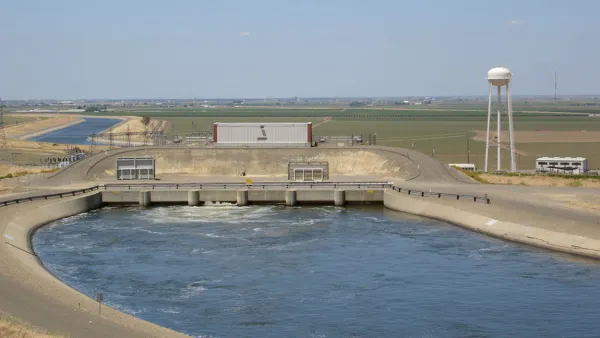
Where the Water Really Goes in California
Golf courses and Los Angeles are the most frequently cited public enemies when droughts hit California, but it isn’t that simple. Recent articles have debunked myths about water use in the Golden State by providing a more accurate portrait of use.
Water Rationing Begins in Parched California Communities (Updated)
As California faces its third dry year in a row, following the driest year in the state's recorded history, communities are facing the prospect of water rationing. However, some of the state's largest cities have been spared for the time being.
Phoenix and Tucson create emergency water reserve, anticipating Colorado River cuts
The Secure Water Arizona Program will allow participating cities to use a reserve of water or make agreements to buy it from other jurisdictions.

The state-sanctioned urbicide of Austin
People don’t kill cities. Freeways do.

US to reduce Colorado River water deliveries to Mexico
A new Colorado Treaty amendment reduces Mexico’s Colorado River water allocation by 250,000 acre feet.

New Jersey’s second-largest city bans standalone data centers
Jersey City will continue to allow co-location facilities, such as those meant for research institutions that store their own data.

Amtrak not solely to blame for New Jersey commuter rail's unreliability, report finds
A new study from the Garden State Initiative found that NJ Transit’s budget grew 20% across a 4 year period, but reliability declined significantly over the same period.

EPA erases limits on planet-warming pollution from power plants
Under Monday’s plan, power plants would still have some limits on how much mercury, arsenic and other contaminants they can emit.

Phoenix announces new on-demand transit service, more frequent RAPID buses
Both new services will launch in October, and are part of Phoenix's Project Effective Access Solutions for Easing Congestion.

FREE Course: Walkable City 1: Why Walkability?
After describing his path towards focusing on walkability as the essence of good planning, Jeff Speck marches through his five principal reasons for making more walkable places.
Reinventing Malls: Planning Alchemy—Turning Gray Fields Into Gold
The course focuses on the opportunities and imperatives that shape reinvention of mall sites.

Eagle County Government
Harvard University Graduate School of Design
Nashville Planning Department
The Architects Foundation
University of Cincinnati Online
The Pocatello Development Authority
The Urban Renewal Agency of the City of Pocatello
Journal of the American Planning Association