Boston recently shut down one of its busiest transit hubs, the Government Center T Station for over-due renovations above and below the ground. The station was originally built in 1898, and without a major renovation since the 1960s.


The Government Center T station in Boston closed this weekend for an expected duration of two years, according to a report by Martine Powers. The renovation will last until spring 2016 and cost $82 million.
The ninth busiest station in the T system has no way for people who use wheelchairs to enter or exit the station. The current layout of the station made a simple retrofit impossible—the station instead requires a comprehensive overhaul where the Blue and Green lines converge.
“For example, when architects sought to find a place to install an elevator between the Blue Line station and the Green Line platform that sits one story above it, there was only one spot that aligned with both platforms — and that spot is where the stairs are now. Construction crews will have to demolish the stairs and rebuild them elsewhere before installing the elevators.”
When the project is done, the station will also have a new public face to alleviate “the look and feel of dreary, windswept City Hall Plaza.” Aboveground improvements will include “innovative landscaping and a gleaming, four-story glass headhouse designed to reshape the look and feel of dreary, windswept City Hall Plaza.”
Read the full story: Government Center closing for 2 years for upgrades
An App to Help the Visually Impaired Use Transit
The Massachusetts Bay Transportation Authority, working with the University of Massachusetts Amherst, is testing an app that will help the blind navigate Arlington Station in early 2015. The app will eventually be free to use throughout the system.
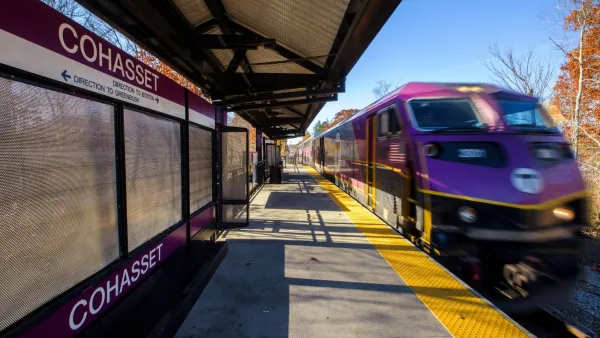
MBTA extends commuter rail discounts and lowers express bus fare to keep passengers riding into the fall
Boston-area commuters can access half-price monthly passes through November.

Boston extends successful fare-free bus pilot
The program began in 2021 and expanded later to include lines 28, 23 and 29.

Planetizen Federal Action Tracker
A weekly monitor of how Trump’s orders and actions are impacting planners and planning in America.

California plans to bury El Niño’s downpour
If the state plays its cards right, it may be able to store a billion acre-feet of El Niño’s water in aquifers.

Desperate measures: Advocates weigh draining Lake Powell to fill Colorado River
Draining the reservoir could reduce evaporation losses by a couple hundred thousand acre-feet.

Chicago voters approve permanent festival grounds, penalty for vacant property owners
Currently, major summer and fall festivals take over public parks for weeks at a time, drawing criticism from nearby residents

NYC votes to cut outdoor dining red tape, speed up permitting
New York City also voted to allow the Department of Transportation to begin work on urgent projects before notifying elected officials.

California appears to reject Prop. 45
The proposition would have expanded the projects that qualify for a streamlined environmental review, effectively paring down the California Environmental Quality Act.

FREE Course: Walkable City 1: Why Walkability?
After describing his path towards focusing on walkability as the essence of good planning, Jeff Speck marches through his five principal reasons for making more walkable places.
Reinventing Malls: Planning Alchemy—Turning Gray Fields Into Gold
The course focuses on the opportunities and imperatives that shape reinvention of mall sites.

City of Rosemead
Rutgers University, Edward J. Bloustein School of Planning and Public Policy
One Hundred Miles
Hunter College, City University of New York (CUNY)
The Architects Foundation
University of Cincinnati Online
City of Cambridge
Montrose County
The Pocatello Development Authority