Suburban locales have typically lagged behind larger cities in building bike-friendly infrastructure. But the League of American Bicyclists' latest round of Bicycle Friendly Communities designations indicate a sea change is happening in the suburbs.


"As we mentioned a few days ago, more suburban-style communities received the League of American Bicyclists’ BFC honor this week," writes Tanya Snyder. "That’s a shift from previous years."
"We wanted to hear more about this suburban bicycling renaissance, so we checked in with the League’s Bill Nesper, director of the Bicycle Friendly America program. He said suburbs often have more work to do than bigger cities to become bike-friendly because of the challenges implicit in their land use."
“Places that don’t really have the density, the average trip distance might not be as short as in a place like New York or Chicago,” said Nesper, “but that isn’t stopping them from making improvements to make bicycling easier for everybody.”
For those cities anxious about being lapped by the 'burbs, assistance awaits: Starting today, the Green Lane Project, a nonprofit program that helps cities design and build better bike lanes, is welcoming applications to join its second two-year round of focus cities.
Read the full story: Suburbs Take Center Stage Among Bicycle Friendly Communities
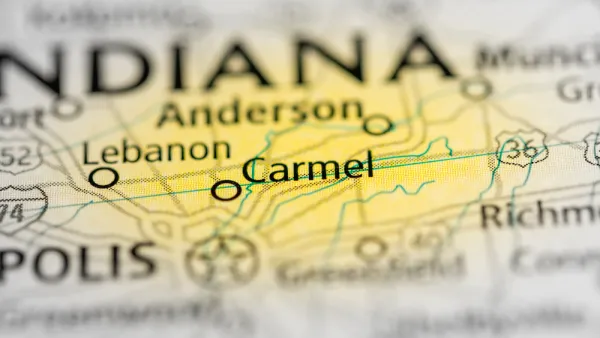
Bike-Friendly City in Indiana is Known for Plentiful Roundabouts
Indiana's fifth-largest city, of just under 100,000, residents has 120 roundabouts, more than any city in the U.S., and only 14 traffic lights. The average traffic fatality rate is 83 percent lower than the national average.
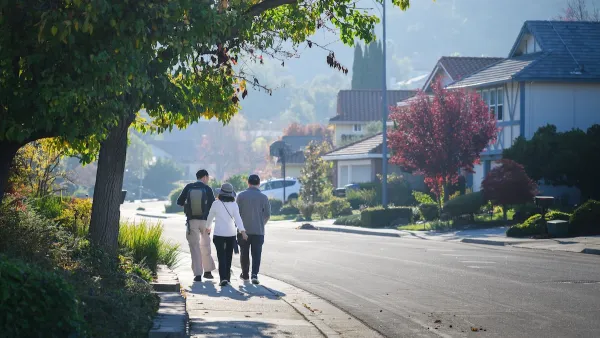
Will sprawl save California?
California residents will vote on Proposition 45 in November, which would make it easier to build large housing developments on the outskirts of the state’s cities.
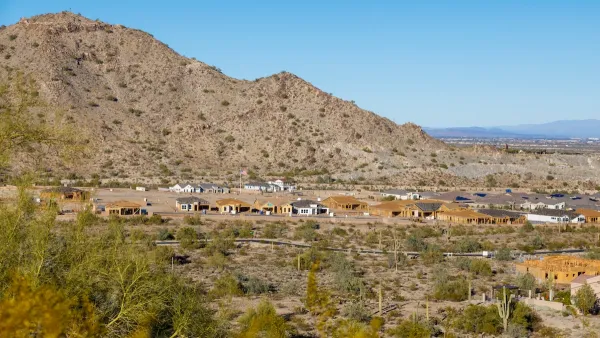
Arizona Overrides Moratorium Imposed due to Water Crisis, Approves up to 60K New Homes
A newly created legal process allows development to proceed if builders agree to bring in renewable water sources and reduce their groundwater use by 25%.

Planetizen Federal Action Tracker
A weekly monitor of how Trump’s orders and actions are impacting planners and planning in America.

California plans to bury El Niño’s downpour
If the state plays its cards right, it may be able to store a billion acre-feet of El Niño’s water in aquifers.

Desperate measures: Advocates weigh draining Lake Powell to fill Colorado River
Draining the reservoir could reduce evaporation losses by a couple hundred thousand acre-feet.

Mamdani’s pied-à-terre tax survives legal challenge
A panel of judges found that the plaintiffs failed to demonstrate injury as a result of New York City's implementation of the tax.

Eastern Nebraska is running out of electricity
Data centers and electrification are straining eastern Nebraska’s grid, throttling economic development.

Seattle passes record-breaking transit services expansion
Proposition 1 will double the city’s transit tax to add 95,000 more bus trips and preserve 180,000 bus trips annually.

FREE Course: Walkable City 1: Why Walkability?
After describing his path towards focusing on walkability as the essence of good planning, Jeff Speck marches through his five principal reasons for making more walkable places.
Reinventing Malls: Planning Alchemy—Turning Gray Fields Into Gold
The course focuses on the opportunities and imperatives that shape reinvention of mall sites.

City of Rosemead
Rutgers University, Edward J. Bloustein School of Planning and Public Policy
One Hundred Miles
University of Michigan School for Environment and Sustainability (SEAS)
Hunter College, City University of New York (CUNY)
The Architects Foundation
City of Cambridge
Montrose County
The Pocatello Development Authority