Apparently there may be a subconscious reason why so many people are attracted to the architecture of Frank Gehry. Using magnetic resonance imaging, researchers have found that our brains are hard-wired to enjoy curvilinear forms.


In a study published earlier this year that's unlikely to surprise anyone familiar with Komar and Melamid's People's Choice project, a research team led by psychologist Oshin Vartanian of the University of Toronto at Scarborough, "reported that test participants were far more likely to consider a room beautiful when it was flush with curves rather than full of straight lines," writes Eric Jaffe.
And those preferences shared a common physiological pathway. "Turns out people looking at curved design had significantly more activity in a brain area called the anterior cingulate cortex, compared to people who were looking at linear decorations," he explains. "The ACC has many cognitive functions, but one is especially noteworthy in the context of Vartanian's study: its involvement in emotion."
Read the full story: Why Our Brains Love Curvy Architecture


Draft Los Angeles River Master Plan Revealed
A new draft Los Angeles Master Plan, created by Frank Gehry's firm, lays out a more active, natural vision for the river, in addition to addressing concerns about displacement in communities along the river corridor.
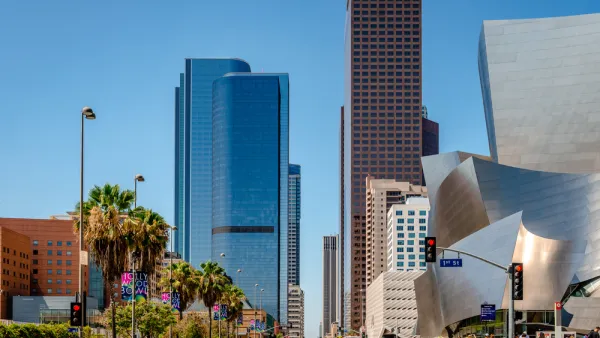
Gehry's Latest Downtown L.A. Project Rises While Workers Stay Home
A high-profile project in the heart of the cultural and civic center of Downtown Los Angeles is rising quickly, and practically in secret, as the area's daytime population stays home during the pandemic.

First Look at the New Eisenhower Memorial in Washington, D.C.
The idea for the Eisenhower was approved by Congress in 1999, and though the opening date for the Frank Gehry-designed memorial was delayed from May 2020, the public will finally get a chance to see newest memorial in D.C. this September.

Planetizen Federal Action Tracker
A weekly monitor of how Trump’s orders and actions are impacting planners and planning in America.

Amtrak, CN end decades-long dispute with eight-year agreement
The new operating agreement establishes an updated framework for the companies to work together, including processes to resolve disputes.

Judges permit Denver to divert 77,000 acre feet from the Colorado River for reservoir expansion
Overuse and climate change have caused the Colorado River’s water levels to plummet.

Atlanta City Council unanimously backs $3.5 billion Beltline light rail project
The resolution was drafted after Atlanta Mayor Andre Dickens pulled support for the Atlanta Streetcar extension last year.

SEPTA to bring nearby frequent transit to over 1 million new riders as part of decade-long plan
The agency's Accelerate plan will also bring frequent transit to twice the amount of jobs that are currently located near it.

NYC plants over 18,000 trees, the most new foliage in a decade
Many of the trees were planted in communities vulnerable to extreme heat.

FREE Course: Walkable City 1: Why Walkability?
After describing his path towards focusing on walkability as the essence of good planning, Jeff Speck marches through his five principal reasons for making more walkable places.
Reinventing Malls: Planning Alchemy—Turning Gray Fields Into Gold
The course focuses on the opportunities and imperatives that shape reinvention of mall sites.

City of Thousand Oaks
City of Wisconsin Rapids
Harvard University Graduate School of Design
The Architects Foundation
University of Cincinnati Online
The Pocatello Development Authority
The Urban Renewal Agency of the City of Pocatello