The idea for the Eisenhower was approved by Congress in 1999, and though the opening date for the Frank Gehry-designed memorial was delayed from May 2020, the public will finally get a chance to see newest memorial in D.C. this September.


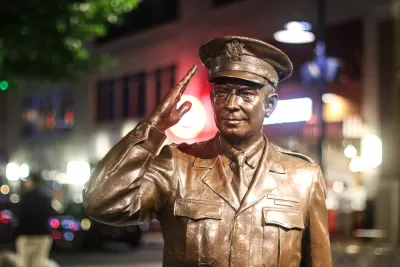
Not everything about the new Eisenhower Memorial, designed by Frank Gehry, works, according to an architectural review by Philip Kennicott. "But at night, with the lights on, it is magical."
The Eisenhower Memorial is scheduled to open to the public on September 17, after a pandemic-induced delay from the original planned opening date of May 3, the original opening day falling on the 75th anniversary of the day Allied forces accepted Germany's surrender in World War II.
"Yet with the exception of some trees that need to be replaced, the memorial is essentially finished, and although the public can’t wander through it now, it is easily seen through and above the surrounding fence," reports Kennicott.
After catching the reader up on some of the setbacks during a design process undertaken in several iterations by Gehry, one of the most famous architects in the world, after the memorial was approved in 1999 during the Clinton administration, Kennicott turns the attention of the article of an assessment of the new memorial's design merits:
It is unlike any other memorial in Washington, or the world. The design was largely dictated by the awkward site, a four-acre patch of land just south of Independence Avenue, opposite the Smithsonian’s National Air and Space Museum. The south side of the square is occupied by the U.S. Education Department’s Lyndon Baines Johnson Building, an oblong modernist box with few lovable features. The site is also bisected by Maryland Avenue, which offers a particularly fine view of the U.S. Capitol, a view that preservationists and oversight groups felt had to be protected.
Gehry’s response to the site was deft and daring. He proposed a giant screen, dubbed a tapestry, along the south edge, effectively veiling the Education Department. The idea of a metal tapestry with a representational image on it was both a reference to an earlier memorial tradition — woven-cloth tapestries were used for centuries to glorify emperors, kings, the victors in battle — and a radical departure from the tradition of using solid stone as the essential medium for monuments. But the tapestry also allowed Gehry to create a parklike space in front of it, a little green oasis in a part of the city that is famous mainly for its dispiriting bureaucratic architecture.
The key notes of praise, however, are found in Kennicott's description of the memorial as experienced at night, where the scene becomes magical. And, yes, the source article has photos of the real thing.
Read the full story: The new Eisenhower Memorial is stunning, especially at night. But is this the last of the ‘great man’ memorials?


Back to the Drawing Board for Eisenhower Memorial Design
The National Capital Planning Commission voted this week to reject a design by Gehry Partners for a memorial to Dwight D. Eisenhower planned for the National Mall in the nation’s capital.
Controversial Eisenhower Memorial Gets Another Update and Crucial Commission Approval
The long-running saga surrounding Frank Gehry's design for a memorial to Dwight D. Eisenhower may actually be heading towards a resolution with last week's vote of approval from the Eisenhower Memorial Commission.
On the Growing Controversy Over Gehry's Eisenhower Memorial
Amanda Hurley examines the furor that has developed in the four months since a design by Frank Gehry for a memorial to President Dwight Eisenhower, destined for a four-acre site just off the National Mall in Washington D.C., was made public.

Planetizen Federal Action Tracker
A weekly monitor of how Trump’s orders and actions are impacting planners and planning in America.

The state-sanctioned urbicide of Austin
People don’t kill cities. Freeways do.

Colorado’s Largest Data Center Could Rise Next to Homes — Without a Public Hearing
The proposed campus would consume 11 times the power of Denver International Airport; as it has across the country, opposition mounts.

Nation's most wind-powered state turns to coal as data centers increase energy demand
For the first time in decades, Iowa has increased its generation of coal power.

NYC cools commuters with city's first rain garden above a bus stop
New York City officials say the plants in the rain garden can absorb 16 gallons of rainwater during heavy storms.

Brightline West’s future may rely on $6 billion federal loan
The company has until Nov. 2 to make a $400 million equity investment into its proposed high-speed rail line.

FREE Course: Walkable City 1: Why Walkability?
After describing his path towards focusing on walkability as the essence of good planning, Jeff Speck marches through his five principal reasons for making more walkable places.
Reinventing Malls: Planning Alchemy—Turning Gray Fields Into Gold
The course focuses on the opportunities and imperatives that shape reinvention of mall sites.

Greater Baltimore Committee
Eagle County Government
Harvard University Graduate School of Design
The Architects Foundation
University of Cincinnati Online
The Pocatello Development Authority
The Urban Renewal Agency of the City of Pocatello
Journal of the American Planning Association