New York's chief urban designer, Alexandros Washburn, addresses the monumental task of rebuilding New York after Hurricane Sandy and preparing for the next storm.


In October 2012, as Hurricane Sandy approached New York, Alexandros Washburn defied evacuation orders and stayed fast in his home in Red Hook, watching as his street flooded and became a "full-fledged river." But he had good reason; the city's chief urban designer wanted to observe first-hand "the dynamics of the storm surge and its effect on our streets and structures."
In an excerpt on Places from his new book The Nature of Urban Design, Washburn recounts his experience during the storm and the hugely complicated — and ongoing — municipal recovery and response. Like average citizens, he's tangled up in the bureacracy of rebuilding: "For weeks I have been working on plans to rebuild the ground floor of my house. It’s frustrating; the rules keep changing. A couple of months ago, the mayor issued an executive order mandating higher levels for rebuilding. Then the federal government issued a new set of 'advisory base flood elevations.' Now those are rumored to be changing, too. The new flood height is almost five feet above my ground floor. I’m as confounded as my neighbor: What do I do?"
FULL STORY: Resilience in Red Hook

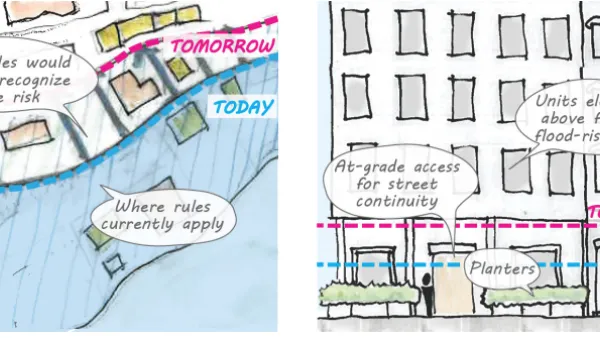
Proposed Citywide Rezoning Would Layer Resilience in New York City
With 520 miles of coastline, New York City is ready to implement the lessons of Hurricane Sandy in the zoning code for the entire city.
Why New York City's Flooding Its Own Subway Entrances
MTA reassured disoriented New Yorkers that it's flooding subway entrances on purpose, to test barriers that it hopes will guard the system against another Sandy.

Taking on Climate Change Without Wrecking Cities for the Poorest and Most Vulnerable
Rebuilding and repairing New York City after Hurricane Sandy shows how climate change can exacerbate existing equity problems and that such disasters must spur efforts to rebuild fairly, not entrench existing problems.

The state-sanctioned urbicide of Austin
People don’t kill cities. Freeways do.

US to reduce Colorado River water deliveries to Mexico
A new Colorado Treaty amendment reduces Mexico’s Colorado River water allocation by 250,000 acre feet.

New Jersey’s second-largest city bans standalone data centers
Jersey City will continue to allow co-location facilities, such as those meant for research institutions that store their own data.

Amtrak not solely to blame for New Jersey commuter rail's unreliability, report finds
A new study from the Garden State Initiative found that NJ Transit’s budget grew 20% across a 4 year period, but reliability declined significantly over the same period.

EPA erases limits on planet-warming pollution from power plants
Under Monday’s plan, power plants would still have some limits on how much mercury, arsenic and other contaminants they can emit.

Phoenix announces new on-demand transit service, more frequent RAPID buses
Both new services will launch in October, and are part of Phoenix's Project Effective Access Solutions for Easing Congestion.

FREE Course: Walkable City 1: Why Walkability?
After describing his path towards focusing on walkability as the essence of good planning, Jeff Speck marches through his five principal reasons for making more walkable places.
Reinventing Malls: Planning Alchemy—Turning Gray Fields Into Gold
The course focuses on the opportunities and imperatives that shape reinvention of mall sites.

Eagle County Government
Harvard University Graduate School of Design
Nashville Planning Department
The Architects Foundation
University of Cincinnati Online
The Pocatello Development Authority
The Urban Renewal Agency of the City of Pocatello
Journal of the American Planning Association