The Federal Highway Administration's recent support for the use of an ITE/CNU authored walkable urban thoroughfares guide as a companion to the widely used AASHTO "Green Book" gives local transportation engineers more tools to create livable streets.


"Last month, the Federal Highway Administration gave its stamp of approval to two new engineering guides: the National Association of City Transportation Officials’ bikeway design guide, which features street treatments like protected bike lanes, and Designing Walkable Urban Thoroughfares: A Context Sensitive Approach, designed to help cities build streets that are walkable and safe for all users," reports Angie Schmitt.
"Ian Lockwood, a livable transportation engineer and principal with AECOM, says AASHTO’s Green Book already provides the kind of flexibility that allows engineers to do good projects that benefit urban environments," notes Schmitt. "But this new guide could push a more innovative approach to livable streets."
“Efforts like this are ways to interpret the AASHTO guidelines and related guidelines to make it easier to do something a little more enlightened,” he said. “This raises awareness; it gives people examples. It gives them what we call ‘cover.’ If engineers start to follow them, they can say it’s endorsed, bona fide.”
Read the full story: FHWA Endorses Engineering Guide for Walkable Urban Streets
Designing Walkable Urban Thoroughfares
That's the title of a new report from CNU and the Institute of Transportation Engineers (ITE) that attempts to right the wrongs of the car-centric street design of the past 75 years.
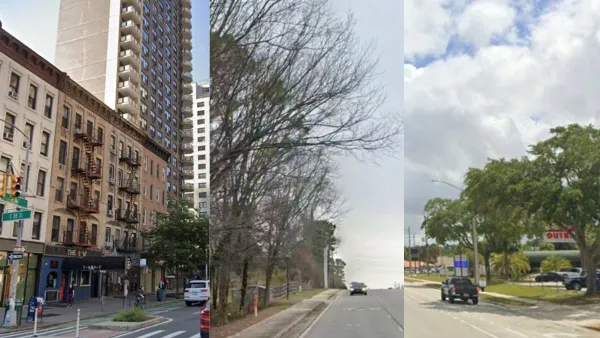
A Transect of sprawl
A development pattern this lifestyle-defining deserves its whole own classification system.

Washington state to charge fee to drivers with fuel-efficient cars
Revenue from the fee will go towards supporting the state’s highways.

Illinois considers spending $1 billion in taxpayer money on data center
A quantum computing campus and data center are currently under construction in Chicago.

Trump to blast ‘hydrocarbon highway’ through ‘world’s longest art gallery’
Environmental and historic preservation groups are suing to stop the project.

NYC, state sue feds over mixed-immigration-status housing assistance rule
The state’s lawsuit argues that the rule change violates the Administrative Procedure Act.

Michigan to turn neighborhood into virtual power plant
Residents will soon be able to divert their excess energy to the grid in exchange for compensation.

Data center, mining project swarm to long-awaited Alaska railroad line
The state-owned railroad approved final plans for the spur line this week; the project is expected to cost $311 million, mostly funded by the federal government

FREE Course: Walkable City 1: Why Walkability?
After describing his path towards focusing on walkability as the essence of good planning, Jeff Speck marches through his five principal reasons for making more walkable places.
Reinventing Malls: Planning Alchemy—Turning Gray Fields Into Gold
The course focuses on the opportunities and imperatives that shape reinvention of mall sites.

City of Charlotte
City of Rosemead
Rutgers University, Edward J. Bloustein School of Planning and Public Policy
University of Michigan School for Environment and Sustainability (SEAS)
Hunter College, City University of New York (CUNY)
The Architects Foundation
University District Partnership