Paul Craig Cobb was welcomed to a small town in North Dakota when he arrived last year and bought 12 plots of land. Now, his neighbors are distressed since learning of his plans to turn Leith, ND into a white supremacist stronghold.


"In the past two years, Mr. Cobb, a longtime proselytizer for white supremacy who is wanted in Canada on charges of promoting hatred, has bought a dozen plots of land in Leith (pronounced Leeth) and has sold or transferred ownership of some of them to a couple of like-minded white nationalists," writes John Eligon.
"He is using Craigslist and white power message boards to entice others in the movement to take refuge in Leith, about two hours southwest of Bismarck. On one board, he detailed his vision for the community — an enclave where residents fly 'racialist' banners, where they are able to import enough 'responsible hard core' white nationalists to take control of the town government, where 'leftist journalists or antis' who 'come and try to make trouble' will face arrest."
"The revelations have riveted this community and the surrounding area, drawing a range of reactions from disgust to disbelief to curiosity."
The town's residents are concerned about what will happen if Mr. Cobb can actually attract other white supremacists to their town. "People have knocked on Mr. Cobb’s red door to offer to buy back his land and to preach the Gospel. The City Council is looking into potential ordinance or health code violations (his home has no septic tank or running water). There is a doomsday plan in place, [Mayor Ryan] Schock explained: If enough of Mr. Cobb’s friends move in to gain a majority that could vote out the current government, the Council would immediately dissolve the town."
Read the full story: New Neighbor’s Agenda: White Power Takeover


Racial Segregation in U.S. Neighborhoods
Despite the intentions of the nation's fair housing laws, neighborhoods in the United States continue to segregate by race.

The Race Barriers of American Cities
The United States has a long and insidious history of erecting structures to control the movements of African Americans in urban and suburban spaces.
Comparing the Racial Segregation of U.S. Cities
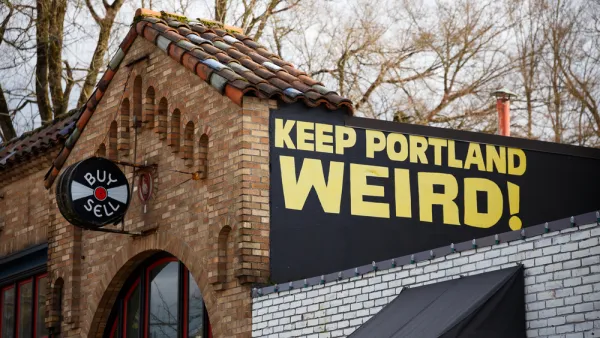
The City Observatory used American Community Survey from the U.S. Census to compare the segregation of the largest U.S. cities. Portland is the most integrated American city; Detroit is the most segregated U.S. city.

Planetizen Federal Action Tracker
A weekly monitor of how Trump’s orders and actions are impacting planners and planning in America.

Amtrak, CN end decades-long dispute with eight-year agreement
The new operating agreement establishes an updated framework for the companies to work together, including processes to resolve disputes.

Judges permit Denver to divert 77,000 acre feet from the Colorado River for reservoir expansion
Overuse and climate change have caused the Colorado River’s water levels to plummet.

NYC DOT wants faster, more permanent street upgrades
The city is examining ways to build more concrete infrastructure without getting entangled in 'decades-long' projects.

'Something we’ve never seen before:' rising utility rates could strain city finances nationwide
Data centers, climate change and other factors have caused utility rates in the United States to increase by 38% since 2020.

Trump to overrule local leaders, lease millions of acres of America’s Pacific Island territories’ seafloors to mining companies
International law says that the Indigenous people of America’s territories have a right to prior and informed consent regarding projects that impact their countries.

FREE Course: Walkable City 1: Why Walkability?
After describing his path towards focusing on walkability as the essence of good planning, Jeff Speck marches through his five principal reasons for making more walkable places.
Reinventing Malls: Planning Alchemy—Turning Gray Fields Into Gold
The course focuses on the opportunities and imperatives that shape reinvention of mall sites.

Harvard University Graduate School of Design
KFH Group Inc.
Greater Baltimore Committee
The Architects Foundation
University of Cincinnati Online
The Pocatello Development Authority
The Urban Renewal Agency of the City of Pocatello