While the New Hampshire bill made it through the House, it was blocked, as Republican leaders had predicted, in the Senate. The Iowa bill, sponsored and supported by Republicans, was never acted on. Iowa may try again next year; not possible in N.H.


Legislators in two states attempted to address deteriorating roads and bridges in their communities. Action in N.H. and the end of the legislative season in Iowa occurred on May 23, one day before the collapse of the Interstate 5 bridge in Washington state.
Dan Tuohy writes that the New Hampshire Senate voted 18-6 on May 23 to "indefinitely postpone" House Bill 617 which would have increased the state's gas tax by 12 cents over three years, or 67%. Prior to that vote, a vote to re-refer the bill to committee died, "effectively nixing it this session."
John Distaso of the New Hampshire Union Leader writes that the earlier vote "means the 'subject matter' of the bill cannot be resurrected again in the current two-year session."
The gas tax bill became entangled with a bill to legalize one "high-end" casino, passed by the Senate and blocked by the House. Senators may have opposed the gas tax bill as retribution for blocking their casino bill, writes Tuohy.
"This is obviously retribution for the gambling vote," said Rep. David Campbell, D-Nashua, the chief House gas tax hike sponsor. His bill called for the first hike in the gasoline tax in the state since 1991, from the current 18 cents to 30 cents a gallon over three years at 4-cent increments and for diesel fuel over six years at 2-cent increments. (Union Leader)
Senate Democratic Leader Sylvia Larsen, D-Concord, warned, "You are closing the door on our being able to discuss our roads and bridges, our red-listed bridges, including Interstate 93 and the Sarah Long Bridge in Portsmouth. It's a huge parliamentary mistake." (Union Leader)
Meanwhile, in the Midwest, Mike Wiser of the Waterloo Cedar Falls Courier writes on May 24 that the legislative season ended with no action taken to hike the fuel tax to act on recommendations made by a commission.
Lawmakers have debated raising the state's fuel tax, which has not increased since 1989 and is set at 22 cents, for years. In 2012, a commission appointed by Gov. Terry Branstad recommended an increase of 8 to 10 cents, plus boosts in certain fees, to pay for the backlog of road repairs estimated at $250 million annually.
Draft language for a bill was written by the Republican chairman of the House Transportation Committee "that would raise the fuel tax by a dime over a three-year period."
Some of the state's most influential and moneyed lobbying groups lined up behind the tax increase, including the road builders and general contractors.
But it faced stiff opposition from the Republican Party of Iowa and anti-tax groups such as Americans For Prosperity. Ultimately, the fuel tax was never called for a vote after a trio of Senate Republicans indicated they would no longer support an increase, even though they once had.
However, unlike the N.H. gas tax bill, Wiser notes that the failure to take action "practically ensures some form of a fuel tax proposal will come back in 2014." In addition, the politics in Iowa is very different than in N.H. In Iowa, Republicans are both sponsoring and opposing the bill.
Sen. Tim Kapucian, R-Keystone, called the failure of the fuel tax one of the session's "disappointments."
"I represent a rural areas and a lot of people out in the countryside, farmers in particular, like a gas tax. They think we need to get the roads fixed, especially in the rural areas," he said.
FULL STORY: Bedford Senator Leads Fight, NH Senate Nixes Gas Tax Hike

State Gas Tax Update: One Up, One Down
This has been an eventful week for gas taxes. To update two posts that appeared recently, Gov. Terry Branstad of Iowa signed legislation that increases the gas tax by 10-cents on March 1. In California, a board voted to decrease the tax by six cents.
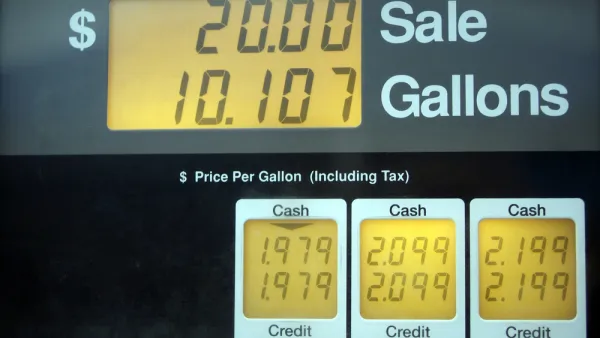
Three States Hope to Take Advantage of Low Gas Prices to Boost Gas Taxes
A movement at the state and federal levels would take advantage of low oil prices to boost gas taxes to pay for infrastructure. Michigan, Iowa, and Utah proposals, and a change to the federal Corker-Murphy plan, are described below.
Governors Blame Congress for Failure to Sustain Highway Trust Fund
Bipartisan governors faulted Congress for failing to find long-term funds for the Highway Trust Fund, but how do their state records match their rhetoric aimed at raising federal gas taxes? Planetizen looks at some of the governors cited in the WSJ.

The state-sanctioned urbicide of Austin
People don’t kill cities. Freeways do.

US to reduce Colorado River water deliveries to Mexico
A new Colorado Treaty amendment reduces Mexico’s Colorado River water allocation by 250,000 acre feet.

New Jersey’s second-largest city bans standalone data centers
Jersey City will continue to allow co-location facilities, such as those meant for research institutions that store their own data.

Amtrak not solely to blame for New Jersey commuter rail's unreliability, report finds
A new study from the Garden State Initiative found that NJ Transit’s budget grew 20% across a 4 year period, but reliability declined significantly over the same period.

EPA erases limits on planet-warming pollution from power plants
Under Monday’s plan, power plants would still have some limits on how much mercury, arsenic and other contaminants they can emit.

Phoenix announces new on-demand transit service, more frequent RAPID buses
Both new services will launch in October, and are part of Phoenix's Project Effective Access Solutions for Easing Congestion.

FREE Course: Walkable City 1: Why Walkability?
After describing his path towards focusing on walkability as the essence of good planning, Jeff Speck marches through his five principal reasons for making more walkable places.
Reinventing Malls: Planning Alchemy—Turning Gray Fields Into Gold
The course focuses on the opportunities and imperatives that shape reinvention of mall sites.

Eagle County Government
Harvard University Graduate School of Design
Nashville Planning Department
The Architects Foundation
University of Cincinnati Online
The Pocatello Development Authority
The Urban Renewal Agency of the City of Pocatello
Journal of the American Planning Association