Lien Hoang looks at efforts by Vietnam's government to get ahead of rising living standards, and the auto congestion that often accompanies, by building modern transit systems in Hanoi and Ho Chi Minh City.


"A developed city is not one in which the poor get around by car but one in which the rich get around by public transit, a former mayor of Bogotá once said. That’s the vision Vietnam is trying to live up to as it becomes more prosperous," says Hoang.
"But the government’s efforts to finalize work on metro systems for Hanoi and Ho Chi Minh City is being undermined by rising living standards and consumerism. Motorbikes, which were an icon of Vietnam’s economic reforms in the 1980s, are being supplanted by a better status symbol: cars."
"So if the Vietnamese government wants to head off the kind of gridlock that plagues Jakarta and Beijing it would do well to funnel its resources into mass transit — and fast."
"Vietnam can’t delay the push for its first metros; it must get those trains running before a new car culture replaces the country’s motorbike culture. 'Once people get into a car,' [Robert Valkovic, the Asian Development Bank’s transport specialist for Vietnam] warns, 'it’s hard to get them out.'”
Read the full story: Easy Riders

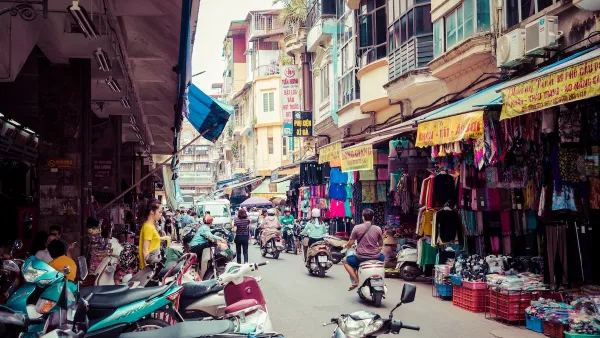
Hanoi to Ban Gas-Powered Two-Wheelers, Later Cars
City officials hope that electrifying motorcycles, a ‘lifeblood’ of Vietnamese transportation, will have a positive impact on air quality and noise in the city’s downtown.
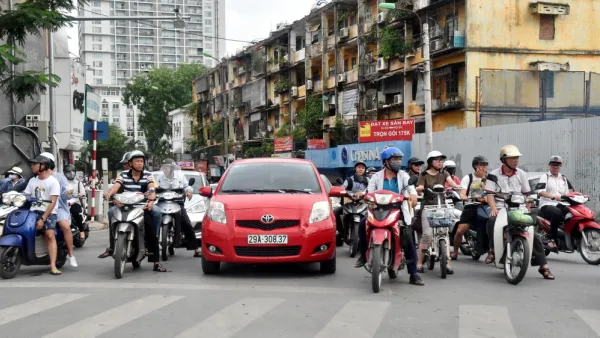
Vietnam Approves Ban on Motorbikes
Vietnam's capitol city Hanoi, following other South East Asian country restrictions on mopeds and two-wheeled vehicles, approves a controversial ban.
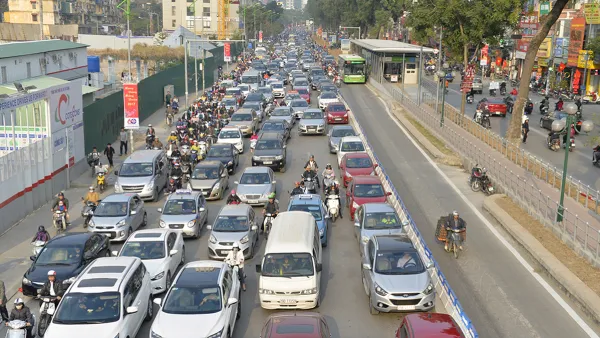
High Hopes and Stiff Resistance for Hanoi's New Bus Rapid Transit
Vietnam's capital is internationally known for pollution and traffic, the government is trying to take on both with a rapid transit bus system, but many remain skeptical.

Planetizen Federal Action Tracker
A weekly monitor of how Trump’s orders and actions are impacting planners and planning in America.

Amtrak, CN end decades-long dispute with eight-year agreement
The new operating agreement establishes an updated framework for the companies to work together, including processes to resolve disputes.

Judges permit Denver to divert 77,000 acre feet from the Colorado River for reservoir expansion
Overuse and climate change have caused the Colorado River’s water levels to plummet.

Northwest rail fans eager for Sept. 30 debut of Amtrak’s Airo fleet
Get ready for that new train smell and more seats. But they won’t go faster or run more frequently on the Cascades route in Washington and Oregon.

NYC DOT wants faster, more permanent street upgrades
The city is examining ways to build more concrete infrastructure without getting entangled in 'decades-long' projects.

'Something we’ve never seen before:' rising utility rates could strain city finances nationwide
Data centers, climate change and other factors have caused utility rates in the United States to increase by 38% since 2020.

FREE Course: Walkable City 1: Why Walkability?
After describing his path towards focusing on walkability as the essence of good planning, Jeff Speck marches through his five principal reasons for making more walkable places.
Reinventing Malls: Planning Alchemy—Turning Gray Fields Into Gold
The course focuses on the opportunities and imperatives that shape reinvention of mall sites.

Harvard University Graduate School of Design
KFH Group Inc.
Greater Baltimore Committee
The Architects Foundation
University of Cincinnati Online
The Pocatello Development Authority
The Urban Renewal Agency of the City of Pocatello