Hanoi's Ancient Quarter, founded in 1010 A.D. and built around a plan from the 15th century, is seeing an entrepreneurial boom. Planners are struggling to maintain the unique character of the community in the process.


Melissa Garcia Lamarca explains the character and history of the neighborhood:
"The urban morphology and function of the Ancient Quarter has, remarkably, remained largely intact throughout Vietnam's more recent history of French colonization and decades of war. Its "spaghetti" street pattern remains from the 15th century, when trade streets emerged that specialized in a particular craft or good, still reflected in street names today. Constant division of properties over the centuries led to the creation of the Quarter's characteristic "tube" or "tunnel" houses, providing live-work spaces for the residents of the area."
Post-Communism, the area surged in popularity and is dealing with issues of preservation and expansion.
Read the full story: The Changing Face of Hanoi's Ancient Quarter

Hanoi to Ban Gas-Powered Two-Wheelers, Later Cars
City officials hope that electrifying motorcycles, a ‘lifeblood’ of Vietnamese transportation, will have a positive impact on air quality and noise in the city’s downtown.
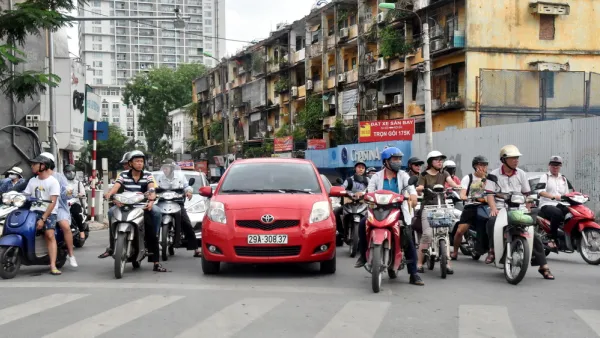
Vietnam Approves Ban on Motorbikes
Vietnam's capitol city Hanoi, following other South East Asian country restrictions on mopeds and two-wheeled vehicles, approves a controversial ban.
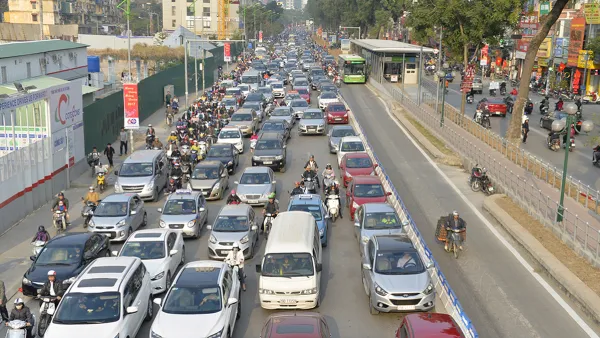
High Hopes and Stiff Resistance for Hanoi's New Bus Rapid Transit
Vietnam's capital is internationally known for pollution and traffic, the government is trying to take on both with a rapid transit bus system, but many remain skeptical.

Planetizen Federal Action Tracker
A weekly monitor of how Trump’s orders and actions are impacting planners and planning in America.

California plans to bury El Niño’s downpour
If the state plays its cards right, it may be able to store a billion acre-feet of El Niño’s water in aquifers.

Desperate measures: Advocates weigh draining Lake Powell to fill Colorado River
Draining the reservoir could reduce evaporation losses by a couple hundred thousand acre-feet.

Mamdani’s pied-à-terre tax survives legal challenge
A panel of judges found that the plaintiffs failed to demonstrate injury as a result of New York City's implementation of the tax.

Eastern Nebraska is running out of electricity
Data centers and electrification are straining eastern Nebraska’s grid, throttling economic development.

Seattle passes record-breaking transit services expansion
Proposition 1 will double the city’s transit tax to add 95,000 more bus trips and preserve 180,000 bus trips annually.

FREE Course: Walkable City 1: Why Walkability?
After describing his path towards focusing on walkability as the essence of good planning, Jeff Speck marches through his five principal reasons for making more walkable places.
Reinventing Malls: Planning Alchemy—Turning Gray Fields Into Gold
The course focuses on the opportunities and imperatives that shape reinvention of mall sites.

City of Rosemead
Rutgers University, Edward J. Bloustein School of Planning and Public Policy
One Hundred Miles
University of Michigan School for Environment and Sustainability (SEAS)
Hunter College, City University of New York (CUNY)
The Architects Foundation
City of Cambridge
Montrose County
The Pocatello Development Authority