France's Environment Ministry has decreed that as of July, all shops and offices in the country will be required to shut off their lights at night in order to save energy and “reduce the print of artificial lighting on the nocturnal environment.”


"France is proud of its lights. Tourists cherish the Christmas illuminations on the Champs-Élysées, the 20,000 flashing bulbs on the Eiffel Tower and the bright, imaginative shop windows of large department stores like Printemps and Galeries Lafayette," says Maia de la Baume. "But France has decided to be 'a pioneer' in preventing light pollution, said Delphine Batho, the environment minister."
"Under the new law, the interior lights of nonresidential buildings will have to be turned off an hour after the last worker leaves, and lights on building facades and in shop windows will have to be extinguished by 1 a.m."
Will the City of Lights have to give up its moniker to, say, Philadelphia? Baume says that major attractions like the Eiffel Tower will remain lighted. Plus, there's no mention in the article that street lights will have to be turned off, so Paris's nocturnal yellow glow should continue. So Philly, it appears you'll have to continue to be associated with these emblems for the time being.
Read the full story: Paris Lights to Be Dimmed to Save Energy
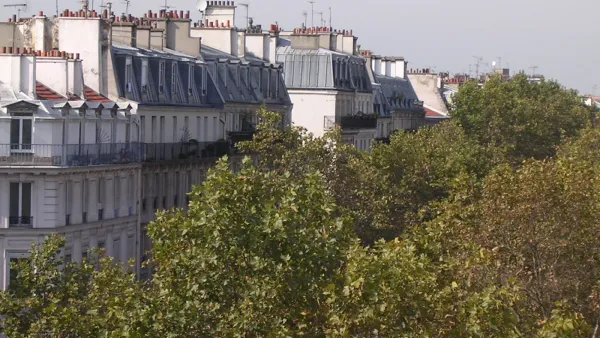
Paris Launches EcoDistrict on Train Station Site
After a decade of development, Paris' first EcoDistrict launched this year. Built in place of a disused train station, the district features offices, housing, and amenities built around clean and green principles.
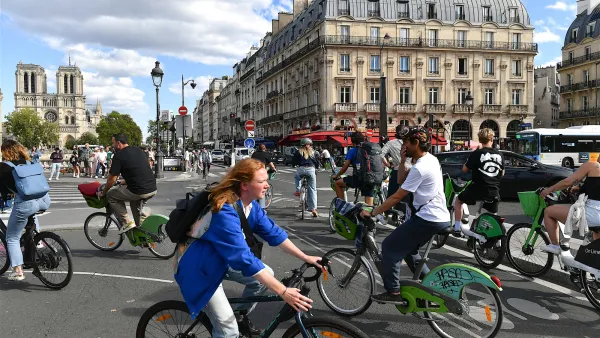
Biking in Paris grew by 240% in 5 years
The city saw a significant rise in bike use thanks to data-driven policy changes.
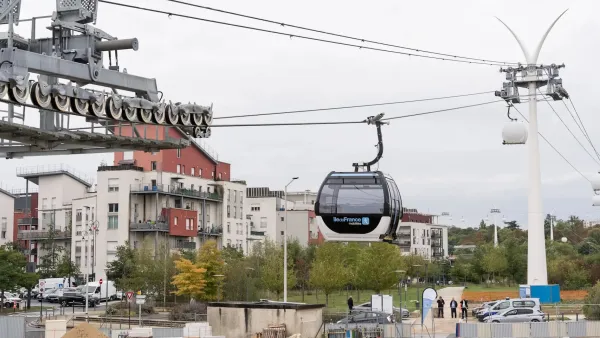
Paris Opens Europe’s Longest Aerial Gondola Line
The new cable car line, France’s seventh, is expected to carry roughly 11,000 passengers per day.

Desperate measures: Advocates weigh draining Lake Powell to fill Colorado River
Draining the reservoir could reduce evaporation losses by a couple hundred thousand acre-feet.

Eastern Nebraska is running out of electricity
Data centers and electrification are straining eastern Nebraska’s grid, throttling economic development.

Malls are becoming the midtowns of the future
Mall and office park redevelopments are a generational opportunity to create new nodes of urbanity.

NYC breaks ground on anti-flooding infrastructure project
New York City's new system will reduce stormwater flows to local sewers by 90%.

One Kentucky town’s secret to affordable housing
The Smoketown Community Land Trust has already built seven affordable homes for community members.

Houston gains petal-shaped cooling infrastructure to make streets more ‘delightful’
The city has installed the pavilions along 15 blocks in Houston.

FREE Course: Walkable City 1: Why Walkability?
After describing his path towards focusing on walkability as the essence of good planning, Jeff Speck marches through his five principal reasons for making more walkable places.
Reinventing Malls: Planning Alchemy—Turning Gray Fields Into Gold
The course focuses on the opportunities and imperatives that shape reinvention of mall sites.

City of Rosemead
Rutgers University, Edward J. Bloustein School of Planning and Public Policy
One Hundred Miles
University of Michigan School for Environment and Sustainability (SEAS)
Hunter College, City University of New York (CUNY)
The Architects Foundation
City of Cambridge
Montrose County
The Pocatello Development Authority