After the city rezoned Williamsburg, affordable housing was supposed to be built on the grounds of a NYCHA project there. Seven years later, ground has not been broken.


Malik Singleton looks at the many entities to blame for the stalled promises to build much needed affordable housing near rapidly gentrifying Brooklyn neighborhoods.
"Seven years ago, when the city rezoned the Greenpoint and Williamsburg neighborhoods to permit high-rise, high-rent construction on the waterfront, affordable housing was part of the deal. Some 3,500 subsidized units were supposed to be generated through a set of programs—including an agreement by the New York City Housing Authority to construct a new affordable housing development on the 12-acre site of its Cooper Park Houses development."
"Today, high-rises have arrived on the banks of the East River. But nothing has happened at Cooper Houses, as conflicting opinions about what should be built and where have stymied any action."
"Now, as the city rebuilds in Sandy's wake and New York City's major agencies are forced to prioritize new projects related to rebuilding efforts, there is a risk that previously planned initiatives will stall indefinitely—especially those that were already slow going, like the one at Cooper Park Houses."
Read the full story: Many Are Responsible for Housing Project's Stall

Report: Greenpoint-Williamsburg Rezoning Sparked Growth
An editorial cites newly released analysis of changes on the North Brooklyn Waterfront since a 2005 rezoning.
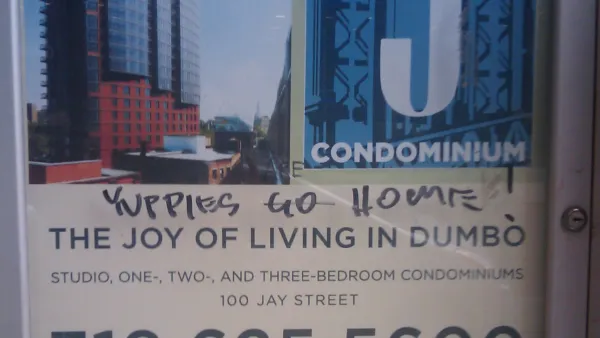
Is Zoning to Blame for Brooklyn's Affordability Crisis?
As waves of gentrification sweep through the poor and middle class neighborhoods of New York City's outer boroughs, Stephen Smith argues that conservative, and outdated, zoning codes are to blame for the unequal balance between supply and demand.
How New York's Hasidim Solved the City's Affordable Housing Problem
The certainly won't win any design awards, but new multi-family residential buildings erected by Hasidic developers in Brooklyn show that it's possible to build spacious and cheap housing in New York for families small and large.

Planetizen Federal Action Tracker
A weekly monitor of how Trump’s orders and actions are impacting planners and planning in America.

The state-sanctioned urbicide of Austin
People don’t kill cities. Freeways do.

US to reduce Colorado River water deliveries to Mexico
A new Colorado Treaty amendment reduces Mexico’s Colorado River water allocation by 250,000 acre feet.

Nation's most wind-powered state turns to coal as data centers increase energy demand
For the first time in decades, Iowa has increased its generation of coal power.

NYC cools commuters with city's first rain garden above a bus stop
New York City officials say the plants in the rain garden can absorb 16 gallons of rainwater during heavy storms.

Brightline West’s future may rely on $6 billion federal loan
The company has until Nov. 2 to make a $400 million equity investment into its proposed high-speed rail line.

FREE Course: Walkable City 1: Why Walkability?
After describing his path towards focusing on walkability as the essence of good planning, Jeff Speck marches through his five principal reasons for making more walkable places.
Reinventing Malls: Planning Alchemy—Turning Gray Fields Into Gold
The course focuses on the opportunities and imperatives that shape reinvention of mall sites.

Greater Baltimore Committee
Eagle County Government
Harvard University Graduate School of Design
The Architects Foundation
University of Cincinnati Online
The Pocatello Development Authority
The Urban Renewal Agency of the City of Pocatello
Journal of the American Planning Association