Philip Bess makes the case for building a permanent community of Benedictines in the new urbanist resort.


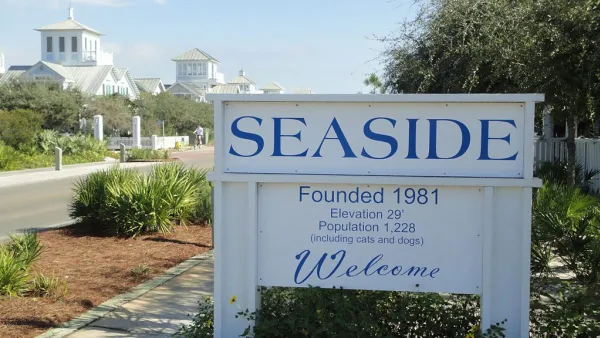
"Seaside's makers appear mindful of sacred order, acknowledged explicitly in two ways. Scott Merrill's neo-American-Carpenter-Gothic Seaside Chapel ("non-denominational") and bell tower-a finely crafted Protestant-cum-Modernist sacred building, abstract but true to type-terminates Seaside's main north-south axis and fronts a public green; and there are plans for a cemetery just east of the Chapel, which when realized will do much to make Seaside's grounding in sacred order more visible. But Seaside still is not a day-to-day town, rather a resort town populated by a handful of permanent residents and many tourists. It remains at best a project that aspires to the fullness of urban culture and place."
"What would bringing Benedictines to Seaside accomplish?" Bess argues, "[t]he main achievement would be a permanent worshipping community in Seaside, the effect of which would be to animate Seaside's currently understated acknowledgement of the sacred order within which Seaside exists."
Thanks to Robert Steuteville
Read the full story: A monastery for Seaside
The Health of Cities Depends on Place-Based Development More than Big Projects
Cities take a physical form that either supports or is stressful to people outside of a moving vehicle or building. Witold Rybczynski, in his critique of New Urbanism, forgets that lesson.
Book Review: Visions of Seaside
A new anthology tells the story of Seaside like we've never heard it before–on its own terms.
The Unbuilt Origins of Seaside
Seaside, Florida is well known as the proving grounds for new urbanism, the place where Andrés Duany and Elizabeth Plater-Zyberk made a development into a town. Dhiru Thadani documents the early experiments and unbuilt designs in a new book.

Washington state to charge fee to drivers with fuel-efficient cars
Revenue from the fee will go towards supporting the state’s highways.

Illinois considers spending $1 billion in taxpayer money on data center
A quantum computing campus and data center are currently under construction in Chicago.

Trump to blast ‘hydrocarbon highway’ through ‘world’s longest art gallery’
Environmental and historic preservation groups are suing to stop the project.

NYC, state sue feds over mixed-immigration-status housing assistance rule
The state’s lawsuit argues that the rule change violates the Administrative Procedure Act.

Michigan to turn neighborhood into virtual power plant
Residents will soon be able to divert their excess energy to the grid in exchange for compensation.

Data center, mining project swarm to long-awaited Alaska railroad line
The state-owned railroad approved final plans for the spur line this week; the project is expected to cost $311 million, mostly funded by the federal government

FREE Course: Walkable City 1: Why Walkability?
After describing his path towards focusing on walkability as the essence of good planning, Jeff Speck marches through his five principal reasons for making more walkable places.
Reinventing Malls: Planning Alchemy—Turning Gray Fields Into Gold
The course focuses on the opportunities and imperatives that shape reinvention of mall sites.

City of Charlotte
City of Rosemead
Rutgers University, Edward J. Bloustein School of Planning and Public Policy
University of Michigan School for Environment and Sustainability (SEAS)
Hunter College, City University of New York (CUNY)
The Architects Foundation
University District Partnership