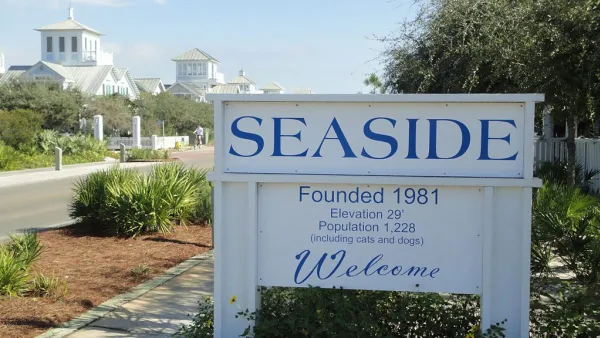
Seaside, Florida is well known as the proving grounds for new urbanism, the place where Andrés Duany and Elizabeth Plater-Zyberk made a development into a town. Dhiru Thadani documents the early experiments and unbuilt designs in a new book.


Though it's become a touchstone for the New Urbanist movement, Seaside was a radical experiment for its day, rejecting the cookie-cutter, auto-oriented development of the time and driven by the idea of creating a real town.
Dhiru Thadani talks about the creation of Seaside in an interview with CNU: "When Andrés first came up with the idea to design a new town, he talked about that it [sic] a lecture he gave at The Catholic University, where I was teaching. My teaching partner and I decided that it would be a wonderful studio project to give to the students. The result was kind of the infancy of what is now called form-based codes."
The students' designs, and those of many other architects, form the backbone of Visions of Seaside, Thadani's new book.
"Some of the lessons that we have talked about in new urbanism, of distance, location, geography, how we can actually have a prominent site, all of those things come into play," explains Thadani in the interview.
Read the full story: Behind the Scenes at Seaside
The Health of Cities Depends on Place-Based Development More than Big Projects
Cities take a physical form that either supports or is stressful to people outside of a moving vehicle or building. Witold Rybczynski, in his critique of New Urbanism, forgets that lesson.
Book Review: Visions of Seaside
A new anthology tells the story of Seaside like we've never heard it before–on its own terms.
Does Seaside Deserve a Rethink?
Often forgotten amid the Truman Show jokes and architectural disdain are the iconic New Urbanist community's contributions to planning history, and its many innovations. Two new works are helping to reframe how the Florida town is understood.

Planetizen Federal Action Tracker
A weekly monitor of how Trump’s orders and actions are impacting planners and planning in America.

California plans to bury El Niño’s downpour
If the state plays its cards right, it may be able to store a billion acre-feet of El Niño’s water in aquifers.

Desperate measures: Advocates weigh draining Lake Powell to fill Colorado River
Draining the reservoir could reduce evaporation losses by a couple hundred thousand acre-feet.

Housing is the top priority of Seattle’s sole new councilmember
Jenks campaigned on building 1,000 new units of affordable housing.

New tax cuts may slash $1.5 billion in funding for Miami transit, public parks
Amendment 3 will save Miami-Dade homeowners $2,700 in 2028.

Arizona, Wisconsin, Pennsylvania hope to finally advance climate goals post-midterms
The three states have spent years under Republican or divided control.

FREE Course: Walkable City 1: Why Walkability?
After describing his path towards focusing on walkability as the essence of good planning, Jeff Speck marches through his five principal reasons for making more walkable places.
Reinventing Malls: Planning Alchemy—Turning Gray Fields Into Gold
The course focuses on the opportunities and imperatives that shape reinvention of mall sites.

City of Rosemead
Rutgers University, Edward J. Bloustein School of Planning and Public Policy
One Hundred Miles
University of Michigan School for Environment and Sustainability (SEAS)
Hunter College, City University of New York (CUNY)
The Architects Foundation
City of Cambridge
Montrose County
The Pocatello Development Authority