Often forgotten amid the Truman Show jokes and architectural disdain are the iconic New Urbanist community's contributions to planning history, and its many innovations. Two new works are helping to reframe how the Florida town is understood.


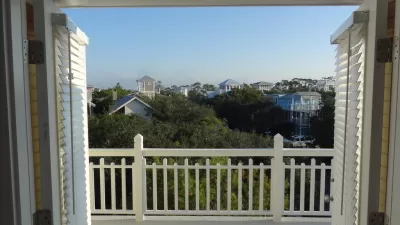
"It’s easy to mock Seaside, and plenty do, for being overplanned, a neo-traditional artifice too consumed with nostalgia for an idyllic past that never quite existed as reconceived," writes Kaid Benfield.
"But the story is so much more good than bad. One has to remember, as the video below reminds us, that the compact, 80-acre town was conceived over 30 years ago, when almost no one was building walkable communities. If it wasn’t sprawl, it didn’t sell, or so people thought. Seaside may have been built on decades-old premises, but it was downright radical for its day."
A new book by Dhiru Thadani, Visions of Seaside, "tells the complete story of Seaside's conception and evolution." And the short documentary below, produced by Chris Elisara for the American Makeover series, explores several of the innovate ideas that form the foundation of the plan, and situates the pioneering development within the context of planning history.
Read the full story: Reconsidering Seaside, Florida
The Health of Cities Depends on Place-Based Development More than Big Projects
Cities take a physical form that either supports or is stressful to people outside of a moving vehicle or building. Witold Rybczynski, in his critique of New Urbanism, forgets that lesson.
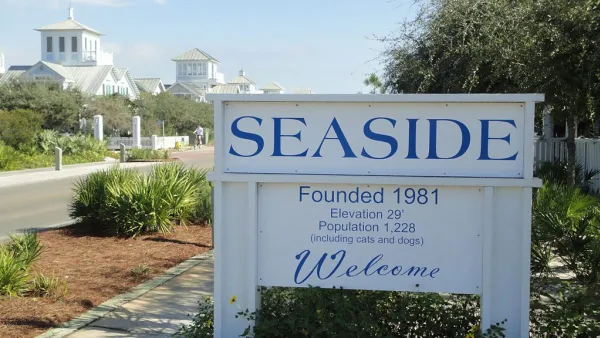
Book Review: Visions of Seaside
A new anthology tells the story of Seaside like we've never heard it before–on its own terms.
The Unbuilt Origins of Seaside
Seaside, Florida is well known as the proving grounds for new urbanism, the place where Andrés Duany and Elizabeth Plater-Zyberk made a development into a town. Dhiru Thadani documents the early experiments and unbuilt designs in a new book.

Washington state to charge fee to drivers with fuel-efficient cars
Revenue from the fee will go towards supporting the state’s highways.

Illinois considers spending $1 billion in taxpayer money on data center
A quantum computing campus and data center are currently under construction in Chicago.

Trump to blast ‘hydrocarbon highway’ through ‘world’s longest art gallery’
Environmental and historic preservation groups are suing to stop the project.

NYC, state sue feds over mixed-immigration-status housing assistance rule
The state’s lawsuit argues that the rule change violates the Administrative Procedure Act.

Michigan to turn neighborhood into virtual power plant
Residents will soon be able to divert their excess energy to the grid in exchange for compensation.

Data center, mining project swarm to long-awaited Alaska railroad line
The state-owned railroad approved final plans for the spur line this week; the project is expected to cost $311 million, mostly funded by the federal government

FREE Course: Walkable City 1: Why Walkability?
After describing his path towards focusing on walkability as the essence of good planning, Jeff Speck marches through his five principal reasons for making more walkable places.
Reinventing Malls: Planning Alchemy—Turning Gray Fields Into Gold
The course focuses on the opportunities and imperatives that shape reinvention of mall sites.

City of Charlotte
City of Rosemead
Rutgers University, Edward J. Bloustein School of Planning and Public Policy
University of Michigan School for Environment and Sustainability (SEAS)
Hunter College, City University of New York (CUNY)
The Architects Foundation
University District Partnership