By better integrating the natural and built environments, while enforcing standards of livability, Copenhagen seeks to transform its Saint Kjeld’s neighborhood into "a showcase area for climate adaptation technology," reports Damian Holmes.


Combining sustainability and livability principles, the city of Copenhagen, with the help of architectural firm TREDJE NATUR, is looking to transform a stretch of its streets and squares into lively public spaces and a laboratory for water management.
According to Holmes, "The project introduces bicycle paths that act as storm water channels, water towers, green roofs, urban gardens, green houses and canals that carry water out from the neighborhood to the harbor. And simultaneously give rise to greater biological diversity in the city."
Developing new methods of diverting rainwater have been incorporated as a focus of the design. "A key concept is the idea that the urban spaces are flooded when it rains and that the water remains in the urban spaces a little longer than usual," says Holmes. "This relieves the sewer systems, and also helps to transform the experience and the use of the urban spaces."
Read the full story: First climate adapted neighborhood | Copenhagen Denmark | TREDJE NATUR

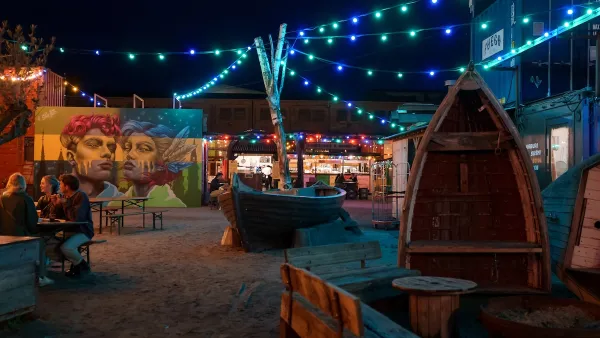
The coolest Copenhagen urban retrofit you’ve never heard of
In Denmark, a ship-building-site-turned-cultural-hub demonstrates the power of mixed-use spaces and organic planning.
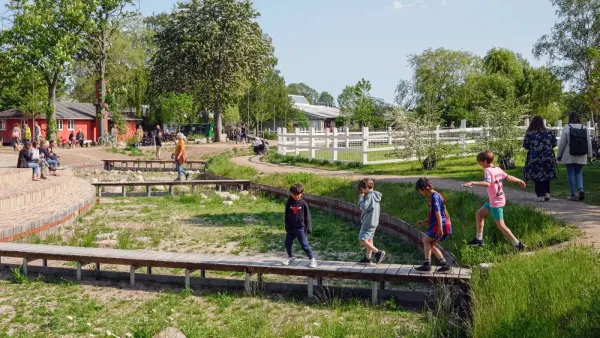
Copenhagen is losing its cool
In a city long designed to maximize light during dark Scandinavian winters, climate change is forcing the Danish capital to rethink its relationship with the sun.

The United States Exits Global Climate Change Network
Mayors from across the U.S. expressed dissatisfaction with the federal government’s decision to withdraw from the United Nations Framework Convention on Climate Change.

Planetizen Federal Action Tracker
A weekly monitor of how Trump’s orders and actions are impacting planners and planning in America.

California plans to bury El Niño’s downpour
If the state plays its cards right, it may be able to store a billion acre-feet of El Niño’s water in aquifers.

Desperate measures: Advocates weigh draining Lake Powell to fill Colorado River
Draining the reservoir could reduce evaporation losses by a couple hundred thousand acre-feet.

California city breaks ground on transit connector
The project includes three mobility hubs and a pedestrian bridge.

After public outcry, Massachusetts city releases housing development tracker
Cambridge’s tracker currently shows 250 housing projects in various stages of development.

40 years after approval, Chicago breaks ground on new park
The park honors Jean Baptiste Point du Sable, the city’s first permanent non-native settler.

FREE Course: Walkable City 1: Why Walkability?
After describing his path towards focusing on walkability as the essence of good planning, Jeff Speck marches through his five principal reasons for making more walkable places.
Reinventing Malls: Planning Alchemy—Turning Gray Fields Into Gold
The course focuses on the opportunities and imperatives that shape reinvention of mall sites.

City of Rosemead
Rutgers University, Edward J. Bloustein School of Planning and Public Policy
One Hundred Miles
Hunter College, City University of New York (CUNY)
The Architects Foundation
University of Cincinnati Online
City of Cambridge
Montrose County
The Pocatello Development Authority