To find Oregon's first energy-neutral building, you'll have to venture 45 minutes outside progressive Portland to the Willamette Valley town of Newberg. There you'll find a first step in an effort to change our physical and cultural environments.


Net-zero building is catching on in America, claims Kelsey Campbell-Dollaghan, and with a market predicted to grow to $1.3 trillion, it's a building type worth paying attention to. Apparently the AIA agrees. Architects Hennebery Eddy recently received an AIA Gold Medal for Portland Community College Newberg, which "consumes zero energy from the grid--a remarkable feat for a large, institutional building--and it's providing a roadmap for other architects hoping to achieve elusive net-zero ratings," writes Campbell-Dollaghan.
Hennebery Eddy's 13,500-square-foot building - seen as a precedent-setting "flagship project" - is the first, crucial step in an effort to build one of the country's first net-zero campuses. The school uses no air conditioning, relying only on passive ventilation, and is connected to bike and bus lanes to promote alternative transportation and reduce carbon emissions.
Overcoming the technological challenges may be the easy part in developing net-zero buildings. It's the "cultural and behavioral changes that go beyond architecture" - such as getting used to hot summers without AC - that may take some time to catch on.
Read the full story: As Net-Zero Building Gains Speed, Portland Tests The Limits
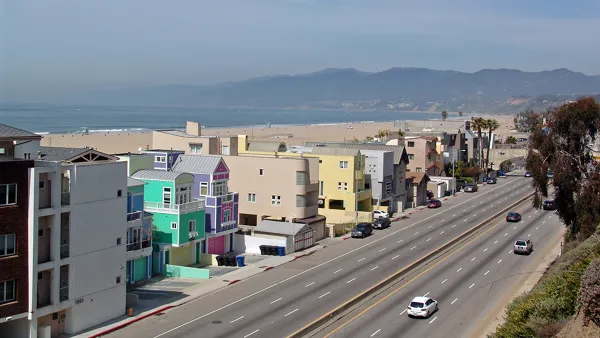
Santa Monica Ordinance Would Require Net-Zero Energy Standards for New Homes
Santa Monica is the first city in California to adopt an ordinance requiring new single-family homes be built to net-zero energy standards.
Self-Cooling Walls Take Climate Control Off the Grid
With anticipated rising global temperatures, the need to cool our homes will take a massive toll on our electrical grid, which a team of masters students aims to address with their new wall insulation.
First Net-Zero Energy Apartments Planned in South Sacramento
Housing 120 units, the first net-zero energy transit-oriented development complex in South Sacramento will feature a rooftop farm and resident-run onsite bicycle repair.

Planetizen Federal Action Tracker
A weekly monitor of how Trump’s orders and actions are impacting planners and planning in America.

California plans to bury El Niño’s downpour
If the state plays its cards right, it may be able to store a billion acre-feet of El Niño’s water in aquifers.

Desperate measures: Advocates weigh draining Lake Powell to fill Colorado River
Draining the reservoir could reduce evaporation losses by a couple hundred thousand acre-feet.

Housing is the top priority of Seattle’s sole new councilmember
Jenks campaigned on building 1,000 new units of affordable housing.

New tax cuts may slash $1.5 billion in funding for Miami transit, public parks
Amendment 3 will save Miami-Dade homeowners $2,700 in 2028.

Arizona, Wisconsin, Pennsylvania hope to finally advance climate goals post-midterms
The three states have spent years under Republican or divided control.

FREE Course: Walkable City 1: Why Walkability?
After describing his path towards focusing on walkability as the essence of good planning, Jeff Speck marches through his five principal reasons for making more walkable places.
Reinventing Malls: Planning Alchemy—Turning Gray Fields Into Gold
The course focuses on the opportunities and imperatives that shape reinvention of mall sites.

City of Rosemead
Rutgers University, Edward J. Bloustein School of Planning and Public Policy
One Hundred Miles
University of Michigan School for Environment and Sustainability (SEAS)
Hunter College, City University of New York (CUNY)
The Architects Foundation
City of Cambridge
Montrose County
The Pocatello Development Authority