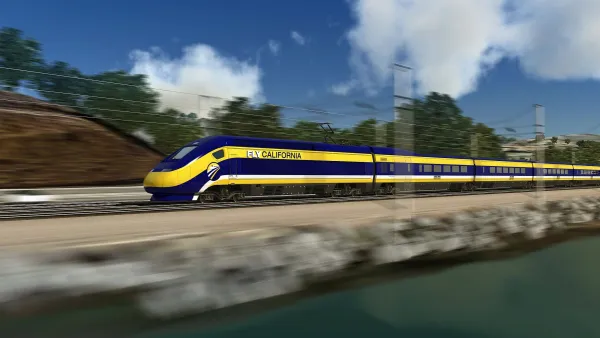
With $8 billion almost in hand (the $4.5 billion in state bonds still need to be sold), the most formidable immediate hurdles are dealing with five lawsuits facing the High Speed Rail Authority. Mike Rosenberg reports that progress has been made.


"The legislative aspect is over, we lost that round. So now it's going to be the litigated phase," said state Sen. Doug LaMalfa, R-Richvale, who led the charge against the project in the Senate. "I don't think there's a complete 'give-up' view yet out there, but it does look tougher."
LaMalfa no doubt was not pleased to read that "(t)wo opponents said for the first time Tuesday (July 10) they are close to reaching settlements with the state: Union Pacific, which for years threatened to stall the project by withholding pivotal rail property along the bullet train route, said it hopes to have a deal with the rail authority "finalized soon." And Peninsula opponents said they're close to settling a four-year court battle over the rail line."
But Gov. Jerry Brown, High Speed Rail Authority chair Dan Richard, and new HSRA CEO Jeff Morales have their work cut out, warns Rosenberg, who lists five serious challenges awaiting the authority, among them:
- Fight off five current lawsuits against the project, with future suits expected.
- Complete high-stakes negotiations with property owners along the route, including powerful groups like big farm businesses.
- Convince investors to buy more than $500 million in state bonds this fall to kick off construction.
Lawsuit update: Two are "in settlement talks on the Peninsula and three in the Central Valley -- against the train are perhaps the project's most formidable challenge. A judge could issue an injunction to halt construction, a worry that prompted Brown last month to propose fast-tracking environmental suits through the courts. While the governor has since backed off in the face of stiff opposition from environmental groups, he's indicated that plan may resurface later."
Rosenberg's editors, meanwhile, continue to blast the high speed rail project as "high-spending folly".
FULL STORY: California's bullet train faces new challenges after funding approval

The California High-Speed Rail Authority's Board Took a 'Momentous' Step on Tuesday
The California High-Speed Rail Authority voted on December 13 to approve two plans that would spend $3.2 billion in high-speed rail bond funds for continuing construction in the Central Valley and help pay for Caltrain commuter rail electrification.
Latest Hotbed of High Speed Rail Opposition: San Fernando Valley
Opposition, followed by legal action to the California High-Speed Rail project began in Northern California, spread to the Central Valley, and now has hit southern California, particularly in the San Fernando Valley of Los Angeles County.
The Potential Downside of Railroad Electrification—for Motorists
Electrification of the Caltrain will be great for train riders, the environment, air quality, and public health, but it might worsen traffic congestion between San Jose and San Francisco by increasing the frequency of commuter trains.

Planetizen Federal Action Tracker
A weekly monitor of how Trump’s orders and actions are impacting planners and planning in America.

The state-sanctioned urbicide of Austin
People don’t kill cities. Freeways do.

US to reduce Colorado River water deliveries to Mexico
A new Colorado Treaty amendment reduces Mexico’s Colorado River water allocation by 250,000 acre feet.

Mamdani overhauls NYC's Vision Zero plan with 100 new policy goals
The overhaul aims to reduce traffic deaths and make streets safer for pedestrians, cyclists and drivers through lower speed limits, new safety infrastructure and more.

Amtrak not solely to blame for New Jersey commuter rail's unreliability, report finds
A new study from the Garden State Initiative found that NJ Transit’s budget grew 20% across a 4 year period, but reliability declined significantly over the same period.

EPA erases limits on planet-warming pollution from power plants
Under Monday’s plan, power plants would still have some limits on how much mercury, arsenic and other contaminants they can emit.

FREE Course: Walkable City 1: Why Walkability?
After describing his path towards focusing on walkability as the essence of good planning, Jeff Speck marches through his five principal reasons for making more walkable places.
Reinventing Malls: Planning Alchemy—Turning Gray Fields Into Gold
The course focuses on the opportunities and imperatives that shape reinvention of mall sites.

Eagle County Government
Harvard University Graduate School of Design
Nashville Planning Department
The Architects Foundation
University of Cincinnati Online
The Pocatello Development Authority
The Urban Renewal Agency of the City of Pocatello
Journal of the American Planning Association