NYC's long-declining waterfront industry is expected to experience a new boom time, as the expansion of the Panama Canal will allow double the cargo and much larger ships to call at New York's harbor by 2024.


John Farley reports how a key vote in Panama held six years ago will impact shipping across North America, and necessitate massive infrastructure investments in New York, including the $1 billion dredging of the Hudson River, the $1 billion raising of the Bayonne Bridge, and the $250 million relocation of siphons used to supply emergency drinking water to Staten Island.
"In 2006, Panamanian voters approved a massive plan to double the shipping capacity of the Panama Canal. The expansion will allow an influx of large, post-Panamax container ships (Panamax refers to the size limit of ships that currently pass through the canal) to travel up the eastern seaboard. The problem is, only the ports in Miami and Norfolk, VA, are able to handle these types of ships on the east coast. Other ports, including the those overseen by the Port Authority of New York and New Jersey, are working fast to update their harbor infrastructure to accommodate these ships. When the big ships come in, starting in 2014, the long-declining waterfront industry is expected to experience a new boom time."
Thanks to Charnee Perez
Read the full story: A Distant Expansion’s Impact on the NYC Waterfront
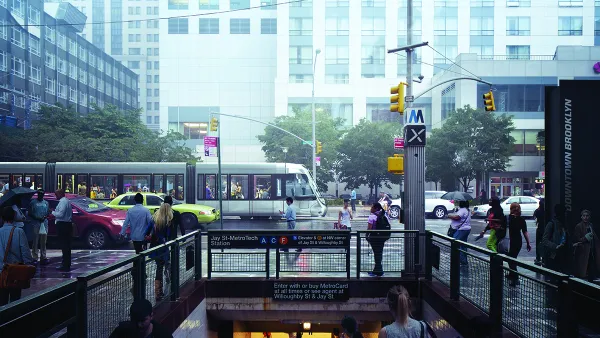
The Brooklyn-Queens Streetcar Plan Won't Die
The Brooklyn-Queens Connector, known as the BQX streetcar, was spotted making plans on the Internet earlier this month.
New York City to Reduce Truck Emissions by Investing in Freight Rail Infrastructure
The Big Apple may claim the nation's highest public transit ridership, but it ranks well below average in its use of freight rail. Two small short line railroads are at the center of a $100 million investment to reduce truck reliance.
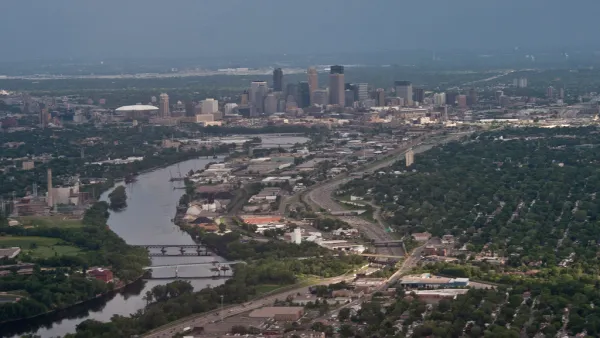
Mayoral Op-Ed Touts New Equitable Development Model in Minneapolis
A plan for 48 acres of riverfront land could make Minneapolis a leader in doing redevelopment right, argue city leaders.

Planetizen Federal Action Tracker
A weekly monitor of how Trump’s orders and actions are impacting planners and planning in America.

Washington state to charge fee to drivers with fuel-efficient cars
Revenue from the fee will go towards supporting the state’s highways.

Trump to blast ‘hydrocarbon highway’ through ‘world’s longest art gallery’
Environmental and historic preservation groups are suing to stop the project.

MBTA Green Line project moved to next phrase of CIG program
The modernization effort will cost $4.08 billion.

22-mile pedestrian and bike path to encircle Atlanta by 2030
The project will also support affordable housing.

Army detonates nearly 5 tons of lead in Iowa
The detonation comes after days of delays and public outcry.

FREE Course: Walkable City 1: Why Walkability?
After describing his path towards focusing on walkability as the essence of good planning, Jeff Speck marches through his five principal reasons for making more walkable places.
Reinventing Malls: Planning Alchemy—Turning Gray Fields Into Gold
The course focuses on the opportunities and imperatives that shape reinvention of mall sites.

City of Charlotte
City of Rosemead
Rutgers University, Edward J. Bloustein School of Planning and Public Policy
University of Michigan School for Environment and Sustainability (SEAS)
Hunter College, City University of New York (CUNY)
The Architects Foundation
University District Partnership