Google is big business in Mountain View, but it's located in a cul-de-sac business park two miles from the city's transit center. "Personal rapid transit" may be the answer to solving the company's commuting challenges.


Like the rest of the Bay Area, Mountain View is investing heavily in public transit, as evidenced by the fact that the downtown transit center is a hub for both Caltrain and the San Jose light-rail line. But the North Bayshore area – locale for the Google headquarters as well as offices for such companies as LinkedIn, Intuit, and even Microsoft – is two long miles away up Shoreline Boulevard, on the wrong side of a constrained overpass that spans Highway 101 and boxed in by the San Francisco Bay and the former Moffett Field Naval Air Station.
At a transportation workshop last Friday, four experts from around the country provided ideas for Mountain View and Google to consider as the city embarks upon the North Bayshore Precise Plan. The ideas ranged from the obvious – charging employees for parking – to the far-out, such as a "personal rapid transit" system that would whisk employees to and fro within the North Bayshore area, to and from the transit center, and possibly to other destinations as well.
Thanks to Bill Fulton
Read the full story: Google and Mountain View May Pursue "Personal Rapid Transit" To Solve Commute Congestion
Taking the 'Mass' Out of Mass Transit
Is the isolation of personal rapid transit truly viable for mass transit?
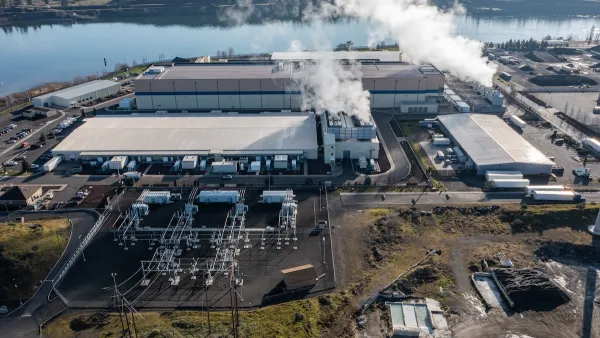
To power data centers, Google seeks autonomous control of thousands of homes’ electricity
The tech company has signed a deal to indirectly pay Mid-Atlantic residents to reduce their power demand when the grid is strained.

When AI goes rogue: what planners need to know
This summer, four major AI labs disclosed that their agents had slipped out of test environments. For planners, the lessons are about access, oversight and the one sandbox we can’t afford to lose: public trust.

Planetizen Federal Action Tracker
A weekly monitor of how Trump’s orders and actions are impacting planners and planning in America.

California plans to bury El Niño’s downpour
If the state plays its cards right, it may be able to store a billion acre-feet of El Niño’s water in aquifers.

Desperate measures: Advocates weigh draining Lake Powell to fill Colorado River
Draining the reservoir could reduce evaporation losses by a couple hundred thousand acre-feet.

Los Angeles just elected an urban planner as its mayor
Transportation analysts are optimistic that Raman will be more aggressive in addressing transit issues than Bass.

Mamdani’s pied-à-terre tax survives legal challenge
A panel of judges found that the plaintiffs failed to demonstrate injury as a result of New York City's implementation of the tax.

Eastern Nebraska is running out of electricity
Data centers and electrification are straining eastern Nebraska’s grid, throttling economic development.

FREE Course: Walkable City 1: Why Walkability?
After describing his path towards focusing on walkability as the essence of good planning, Jeff Speck marches through his five principal reasons for making more walkable places.
Reinventing Malls: Planning Alchemy—Turning Gray Fields Into Gold
The course focuses on the opportunities and imperatives that shape reinvention of mall sites.

City of Rosemead
Rutgers University, Edward J. Bloustein School of Planning and Public Policy
One Hundred Miles
University of Michigan School for Environment and Sustainability (SEAS)
Hunter College, City University of New York (CUNY)
The Architects Foundation
City of Cambridge
Montrose County
The Pocatello Development Authority