With less than two months under his belt as the new chairman of the High Speed Rail Authority, Dan Richard has made significant shifts in strategy for the project and is generating optimism for a fresh start, reports Ken Orski.


Amidst new reports of rising borrowing costs for the bullet train and efforts to introduce measures onto the November ballot calling for a cancellation of the project, "[a] new strategy is beginning to emerge toward California's embattled high-speed rail venture."
"The strategy is designed to rescue the project from a possible defeat at the hands of the state legislature, gain friends and supporters among local transportation agencies, win converts among independent analysts and turn around a largely skeptical public," reports Orski.
Crafted by Richard, with the support of his fellow board members and the Governor, the centerpiece of the new near-term "bookend" strategy, "will involve 'blending' high-speed rail service with commuter rail service in existing Bay Area and Southern California rail corridors," increasing the speed of local commuter trains in preparation for the eventual arrival of high-speed rail.
A new implementation plan is just one aspect of Richard's blitz. He has sought to repair frayed relationships with the Central Valley communities along the proposed route, reestablish credibility with the legislature, and is producing a new budget estimate.
With construction scheduled to begin next year, we should find out soon whether Richard's efforts have been successful.
Read the full story: California’s Bullet Train — A Fresh Start and a Change in Direction
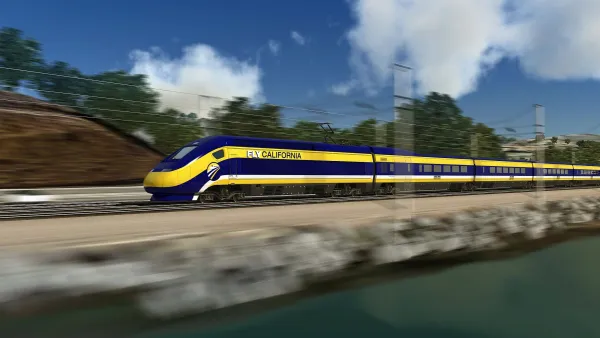
The California High-Speed Rail Authority's Board Took a 'Momentous' Step on Tuesday
The California High-Speed Rail Authority voted on December 13 to approve two plans that would spend $3.2 billion in high-speed rail bond funds for continuing construction in the Central Valley and help pay for Caltrain commuter rail electrification.
A Change of Direction for California High-Speed Rail
In the face of political opposition and mounting construction costs in Southern California, the state High-Speed Rail Authority has chosen to build north from the Central Valley to San Jose rather than south from Fresno to the San Fernando Valley.
Opponents to California High-Speed Rail Board: Show Us the Money!
Bereft of private investment, how can the $68 billion project proceed? That's the question about 20 members of the public repeated in their public comments at Tuesday's High-Speed Rail Authority meeting in Fresno. To their surprise, it was answered.

Desperate measures: Advocates weigh draining Lake Powell to fill Colorado River
Draining the reservoir could reduce evaporation losses by a couple hundred thousand acre-feet.

Eastern Nebraska is running out of electricity
Data centers and electrification are straining eastern Nebraska’s grid, throttling economic development.

Move over, LA: St. Louis gears up for Olympics, invests millions in downtown redevelopment
The Missouri city will host the 2028 Olympic soccer group stage and knockout matches.

Mass. votes against statewide minimum lot size for single-family homes
Over 2 million residents voted on Question 7; it was decided by just over 30,000 votes.

Maryland’s $15 billion bridge project gains key approval
The Maryland Transit Authority said the project will create over 60,000 jobs and add $23 billion to the local economy.

‘No clear next steps’ for Chicago's permanent festival grounds
Eleventh Ward Ald. Nicole Lee has suggested Soldier Field as a possible location for the permanent event space.

FREE Course: Walkable City 1: Why Walkability?
After describing his path towards focusing on walkability as the essence of good planning, Jeff Speck marches through his five principal reasons for making more walkable places.
Reinventing Malls: Planning Alchemy—Turning Gray Fields Into Gold
The course focuses on the opportunities and imperatives that shape reinvention of mall sites.

City of Rosemead
Rutgers University, Edward J. Bloustein School of Planning and Public Policy
One Hundred Miles
University of Michigan School for Environment and Sustainability (SEAS)
Hunter College, City University of New York (CUNY)
The Architects Foundation
City of Cambridge
Montrose County
The Pocatello Development Authority