The good news is that the $390 million renovation of the Javits Center on the west side of Manhattan is coming along well and on target to be completed in 2014. The bad news is it that it will likely be torn down shortly thereafter.


Robin Pogrebin reports on Governor Cuomo's recently announced plans to demolish the Jacob K. Javits Convention Center and replace it with a larger center to be built at the Aqueduct racetrack in Jamaica, Queens, with $4 billion from Genting, a Malaysian gambling company. Pogrebin speaks with Bruce Fowle, architect of the on-going renovation to the original Javits, and others involved with the project.
"The waste of creative energy, money and material that would result in its being torn down is painful to think about," Mr. Fowle said during a walk through the center last week. "When you're worrying about every detail - trying to do the best you can to make something that represents the city - it's like having the rug pulled out from under you."
Some would not be as disappointed by Mr. Fowle by the unusual turn of events. "It's just such an awful building that the only reason to keep it would be as a monument to stupidity," said Mark Wigley, the dean of Columbia University's Graduate School of Architecture, Planning and Preservation, about the original Javits.
Read the full story: Let’s Raze Javits Center (but First Finish Renovations)
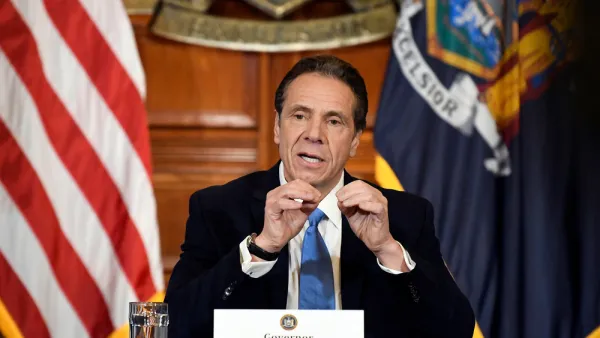
Massive, Expensive Redevelopment of Midtown Manhattan Proposed
New York Governor Cuomo's State of the State speeches last week included an ambitious proposal for a large-scale redevelopment project on Manhattan's west side, adjacent to Penn Station.

The Disconnect Between Virus Prevalence and Local Business Climate
Public health experts assert that to safely reopen the economy, the coronavirus needs to be contained. In Manhattan, where the virus is largely controlled, chain restaurants are closing while their sister stores in Florida are expanding.
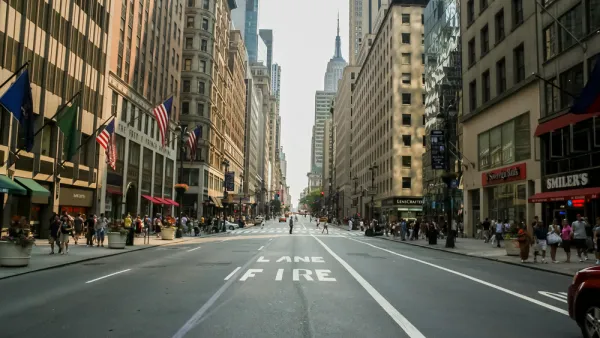
Done Deal: Manhattan Congestion Pricing
Finally, congestion pricing, as applied to city cordons, not highways, will be coming to the U.S., thanks to a budget deal approved by the New York State Legislature early Sunday morning. Tolls below 60th Street should begin by Jan. 1, 2021.

Planetizen Federal Action Tracker
A weekly monitor of how Trump’s orders and actions are impacting planners and planning in America.

California plans to bury El Niño’s downpour
If the state plays its cards right, it may be able to store a billion acre-feet of El Niño’s water in aquifers.

Desperate measures: Advocates weigh draining Lake Powell to fill Colorado River
Draining the reservoir could reduce evaporation losses by a couple hundred thousand acre-feet.

Los Angeles just elected an urban planner as its mayor
Transportation analysts are optimistic that Raman will be more aggressive in addressing transit issues than Bass.

Mamdani’s pied-à-terre tax survives legal challenge
A panel of judges found that the plaintiffs failed to demonstrate injury as a result of New York City's implementation of the tax.

Eastern Nebraska is running out of electricity
Data centers and electrification are straining eastern Nebraska’s grid, throttling economic development.

FREE Course: Walkable City 1: Why Walkability?
After describing his path towards focusing on walkability as the essence of good planning, Jeff Speck marches through his five principal reasons for making more walkable places.
Reinventing Malls: Planning Alchemy—Turning Gray Fields Into Gold
The course focuses on the opportunities and imperatives that shape reinvention of mall sites.

City of Rosemead
Rutgers University, Edward J. Bloustein School of Planning and Public Policy
One Hundred Miles
University of Michigan School for Environment and Sustainability (SEAS)
Hunter College, City University of New York (CUNY)
The Architects Foundation
City of Cambridge
Montrose County
The Pocatello Development Authority