Eliza Griswold profiles the economic, health, and environmental troubles of Amwell Township, PA, after an oil company moves in and begins fracking for natural gas.


"[Range Resources representative Matt] Pitzarella cited a study by the Center for Rural Pennsylvania that found that 40 percent of Pennsylvania's water wells had at least one pre-existing water-quality problem, and that there was no obvious influence on private water-well quality from fracking. In a previous study, 2 percent of the state's wells had arsenic levels that exceeded health standards.
Soon [resident Stacey] Haney and her kids began to notice that even outdoors it smelled a lot like the shower - a combination of sweet metal, rotten eggs and raw sewage. Talking to neighbors, Haney learned that atop a hill, about 1,500 feet from her home and less than 800 feet from that of her neighbor, Beth Voyles, there was an open, five-acre chemical impoundment filled with chemically treated water."
Read the full story: The Fracturing of Pennsylvania

Scrutinizing the Reality of Bernie's Energy and Climate Plans
CNN host Fareed Zakaria questions whether the goals of Sanders' ambitious Green New Deal are realistic.
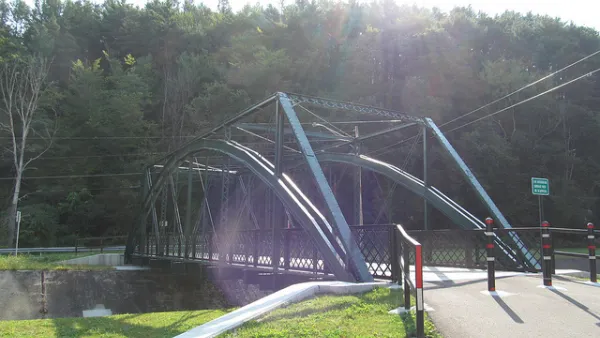
Allegheny River Town Debates Fracking Water Treatment Plant
Opponents cite environmental risks, supporters hope the facility will boost the economy of a struggling community.
Methane Emissions Replace CO2 Emissions— Is This Progress?
For the first time, electricity generated from burning natural gas will surpass coal, largely due to fracking of shale. While that means that carbon dioxide emissions will continue to drop, it also means that methane emissions will increase.

Planetizen Federal Action Tracker
A weekly monitor of how Trump’s orders and actions are impacting planners and planning in America.

Eastern Nebraska is running out of electricity
Data centers and electrification are straining eastern Nebraska’s grid, throttling economic development.

Washington state to charge fee to drivers with fuel-efficient cars
Revenue from the fee will go towards supporting the state’s highways.

Instead of building new housing, LA developers are turning mansions into mega-mansions
In the richest areas, the number of houses valued at $30 million with demolition permits has skyrocketed since 2018.

Illinois considers spending $1 billion in taxpayer money on data center
A quantum computing campus and data center are currently under construction in Chicago.

As development costs rise, Boston moves to lessen affordable housing requirements
The Boston Zoning Commission and the City Council still need to approve Boston Mayor Michelle Wu’s proposed changes

FREE Course: Walkable City 1: Why Walkability?
After describing his path towards focusing on walkability as the essence of good planning, Jeff Speck marches through his five principal reasons for making more walkable places.
Reinventing Malls: Planning Alchemy—Turning Gray Fields Into Gold
The course focuses on the opportunities and imperatives that shape reinvention of mall sites.

City of Charlotte
City of Rosemead
Rutgers University, Edward J. Bloustein School of Planning and Public Policy
University of Michigan School for Environment and Sustainability (SEAS)
Hunter College, City University of New York (CUNY)
The Architects Foundation
University District Partnership
City of Cambridge
The Pocatello Development Authority