Calling it an investment plan in job growth in the transportation sector, the President in a Labor Day speech outlined a six-year plan for investment in road, rail, and airports to be paid for by eliminating tax breaks and subsidies from big oil.


Sure to be difficult to gather the necessary congressional support as the mid-term elections approach, President Obama nevertheless made a strong case for job-producing transportation investment that would also help commuters and long-distance travelers.
"Central to the plan is the president's call for an "infrastructure bank," which would be run by the government but would pool tax dollars with private investment, the White House says.
But the notion of a government-run bank - indeed, a government-run anything - is bound to prove contentious during an election year in which voters are furious over bank bailouts and over what many perceive as Mr. Obama pursuing a big government agenda. Even before the announcement Monday, Republicans were expressing caution.
Specifically, the president wants to rebuild 150,000 miles of road, lay and maintain 4,000 miles of rail track, restore 150 miles of runways and advance a next-generation air-traffic control system."
From Streetsblog: First Impressions of Obama's Big Infrastructure Announcement: Reactions are listed from several sources, including Transportation for America, The Transport Politic and James Rowen at The Political Environment who commented, "I loved the administration's commitment to a national passenger rail system; jobs and growth for Milwaukee will be and already are the local outcomes."
Read the full story: Obama Offers a Transit Plan to Create Jobs

Secretary Foxx Talks Funding (and Possibly Tolling)
A recent article by Yonah Freemark details the policy agenda of Transportation Secretary Anthony Foxx, the former mayor of Charlotte and successor of well-regarded Transportation Secretary Ray La Hood.
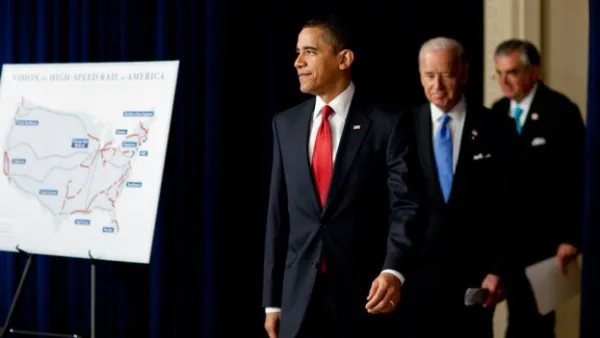
Obama's Grand Rail Plans: What Went Wrong?
Four years after a historic down payment was made on Pres. Obama's plan to connect 80 percent of Americans to fast trains, "the prospects for a national high-speed rail system seem bleak." Politics and funding challenges have derailed the plan.
Analysis: What does America want from surface transportation reauthorization?
Over 13,000 comments were submitted in the federal Request for Information on surface transportation reauthorization. We analyzed all of them.

Planetizen Federal Action Tracker
A weekly monitor of how Trump’s orders and actions are impacting planners and planning in America.

The state-sanctioned urbicide of Austin
People don’t kill cities. Freeways do.

Colorado’s Largest Data Center Could Rise Next to Homes — Without a Public Hearing
The proposed campus would consume 11 times the power of Denver International Airport; as it has across the country, opposition mounts.

Raised interest rates may kill financially vulnerable construction projects
The chief economist at ConstructConnect warns that if construction project owners are negatively impacted by the raised rates, it could result in delayed payments to contractors.

Data centers are consuming nearly 25% of Oregon’s power
The state has 111 data centers, with 32 more either planned or under construction.

A third of Texas cities must update their zoning codes to comply with new housing law
Texas municipalities are now required to allow manufactured housing in at least one residential zoning district.

FREE Course: Walkable City 1: Why Walkability?
After describing his path towards focusing on walkability as the essence of good planning, Jeff Speck marches through his five principal reasons for making more walkable places.
Reinventing Malls: Planning Alchemy—Turning Gray Fields Into Gold
The course focuses on the opportunities and imperatives that shape reinvention of mall sites.

Greater Baltimore Committee
Eagle County Government
Harvard University Graduate School of Design
The Architects Foundation
University of Cincinnati Online
The Pocatello Development Authority
The Urban Renewal Agency of the City of Pocatello
Journal of the American Planning Association