Born from the 1968 riots, a carefully planned community in France has been steadily taken over by crime and unrest, prompting some to question whether its utopian ideals actually work.


The area is now a hotbed of racial clashes and social controversies. Recent waves of crime have underlined the area's decline.
"Villeneuve was a careful mixture of private and public housing, including subsidized apartments for low-income families, with branch offices of city hall and a neighborhood corporation that would take care of public spaces while providing residents construction, plumbing and painting services at moderate costs.
In the spirit of '68, we made a bet, that with this social mixing we could help everyone advance,' said Jean-Philippe Motte, a longtime city councilor from the political left. 'Of course, that was 40 years ago.'
Villeneuve began to deteriorate in the 1990s, with more poverty and joblessness, especially as immigrants from former colonies of the Maghreb and black Africa altered the original social and economic balance. Some of those who could afford to leave did so, and a population of nearly 16,000 dropped to the current 12,000. Three of the original nine schools closed."
Read the full story: Utopian Dream Becomes Battleground in France
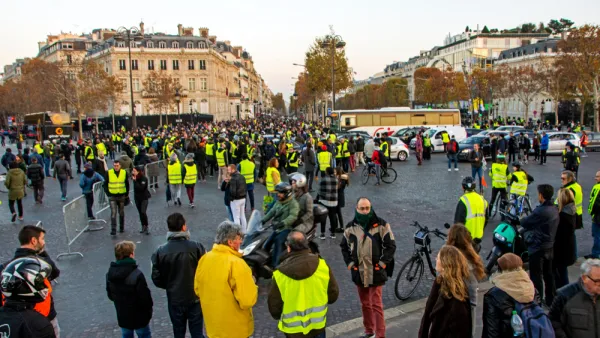
Fuel Tax Hike Revolt Threatens French President Macron's Leadership
Anger at fuel tax increases planned for January, part of a pro-Green agenda espoused by President Emmanuel Macron, has sparked a populous movement involving hundreds of thousands of protestors that have taken to the streets, erupting into violence.
Friday Funny: Blame the Architect, The Video
A lecture series explores the relation between city planning and urban violence. And who is to blame? The architect.
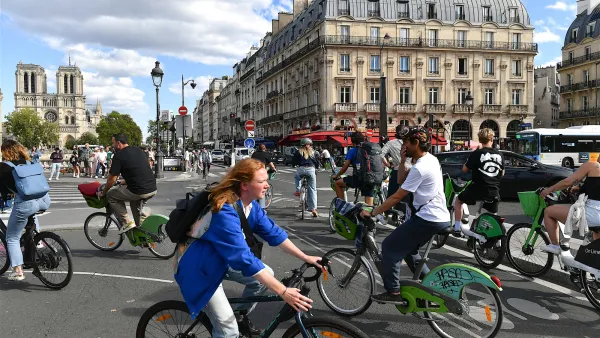
Biking in Paris grew by 240% in 5 years
The city saw a significant rise in bike use thanks to data-driven policy changes.

Planetizen Federal Action Tracker
A weekly monitor of how Trump’s orders and actions are impacting planners and planning in America.

Eastern Nebraska is running out of electricity
Data centers and electrification are straining eastern Nebraska’s grid, throttling economic development.

Study reveals best places in the U.S. for cycling, walking
New research from Streetlight Data examines bicycle and pedestrian miles per capita in the 100 largest U.S. cities by population.

Next-generation nuclear reactors are coming to Texas
The reactors will not require towering containment structures thanks to new safety features.

California distributes $1.3 billion to prevent transit service cuts, bolster projects
Twenty-eight projects across California received a portion of the funding.

Pennsylvania Democrats have 15 affordability, clean energy bills for flipped state Senate
Bills in consideration include a bill supporting geothermal energy and a bill supporting solar on warehouses.

FREE Course: Walkable City 1: Why Walkability?
After describing his path towards focusing on walkability as the essence of good planning, Jeff Speck marches through his five principal reasons for making more walkable places.
Reinventing Malls: Planning Alchemy—Turning Gray Fields Into Gold
The course focuses on the opportunities and imperatives that shape reinvention of mall sites.

City of Charlotte
City of Rosemead
Rutgers University, Edward J. Bloustein School of Planning and Public Policy
University of Michigan School for Environment and Sustainability (SEAS)
Hunter College, City University of New York (CUNY)
The Architects Foundation
City of Cambridge
The Pocatello Development Authority
The Urban Renewal Agency of the City of Pocatello