In an effort to improve accountability, more government agencies are freeing data about public expenditures.


Next American City columnist Christian Madera writes that the federal government and a variety of cities are opening this data up to the public. The trend is also spreading outside of the U.S.
"One often cited example is the City of Toronto, Canada, which publishes the detailed expense records of the City's mayor and council members. In the U.S., Washington, D.C. publishes the details of government purchase orders and credit card transactions as part of its open data catalog. And Cook County, Illinois recently launched a online check register that lists contract payments made by the County.
Other cities are trying to catch up. In New York City, the city's new Public Advocate (an elected post designed to serve as the city's watchdog) announced plans for new website that would provide citizens with information about applications for councilmember discretionary funds – which could potentially be used to reward political supporters. Underwhelmingly, reporting of these applications will be on a voluntary basis by each elected official."
FULL STORY: Following the Money


New Interactive Mapping Tool Tracks all of NYC's Infrastructure Projects, Housing Permits, and City Facilities
The New York Department of City Planning has taken its open data practices to a new level with the launch of the Capital Planning Explorer.
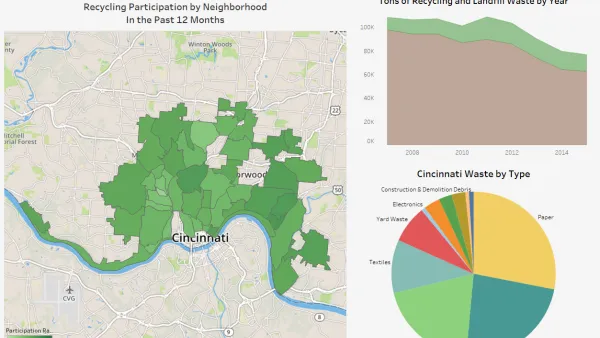
Who Recycles in Cincinnati?
A new CincyInsights dashboard shows recycling participation rates all over the city.
A New Tool to Amplify the Power of Open Data
Open data that no one knows how to use is hardly open at all. A new platform from Esri aims to improve the situation.

The state-sanctioned urbicide of Austin
People don’t kill cities. Freeways do.

US to reduce Colorado River water deliveries to Mexico
A new Colorado Treaty amendment reduces Mexico’s Colorado River water allocation by 250,000 acre feet.

New Jersey’s second-largest city bans standalone data centers
Jersey City will continue to allow co-location facilities, such as those meant for research institutions that store their own data.

Amtrak not solely to blame for New Jersey commuter rail's unreliability, report finds
A new study from the Garden State Initiative found that NJ Transit’s budget grew 20% across a 4 year period, but reliability declined significantly over the same period.

EPA erases limits on planet-warming pollution from power plants
Under Monday’s plan, power plants would still have some limits on how much mercury, arsenic and other contaminants they can emit.

Phoenix announces new on-demand transit service, more frequent RAPID buses
Both new services will launch in October, and are part of Phoenix's Project Effective Access Solutions for Easing Congestion.

FREE Course: Walkable City 1: Why Walkability?
After describing his path towards focusing on walkability as the essence of good planning, Jeff Speck marches through his five principal reasons for making more walkable places.
Reinventing Malls: Planning Alchemy—Turning Gray Fields Into Gold
The course focuses on the opportunities and imperatives that shape reinvention of mall sites.

Eagle County Government
Harvard University Graduate School of Design
Nashville Planning Department
The Architects Foundation
University of Cincinnati Online
The Pocatello Development Authority
The Urban Renewal Agency of the City of Pocatello
Journal of the American Planning Association