The Department of Transportation has decided that the proposed Las Vegas - Southern California maglev train was not far enough along to be eligible for funding, which is meant to go towards more immediate solutions.


Sen. Harry Reid is taking a lot of heat for his failure to secure the federal funds. It also appears that the privately-developed Desert Xpress train from Victorville may have diverted attention away from the slower maglev proposal.
Steve Tertreault writes, "The maglev project involving Las Vegas, which has been in planning since 1988, encountered a setback last summer when Reid, who had been its chief patron in Congress, said he would wait no longer for progress and announced he was switching his support to Desert XPress.
Reid said at the time he would seek to redirect a $45 million earmark that he had placed in a 2005 transportation bill for maglev, on the grounds the project was not prepared to spend the funds."
Read the full story: Nevada's high-speed rail plan deemed ineligible for stimulus funds

California’s Brightline West High-Speed Rail Announces 2029 Completion Date
The Las Vegas-to-Southern California rail line was originally slated to open for service in time for the 2028 Olympics.

LA-to-Vegas High-Speed Rail Cost Jumps by $5.5 Billion
Brightline West is asking USDOT for a $6 billion loan to help cover rising costs.
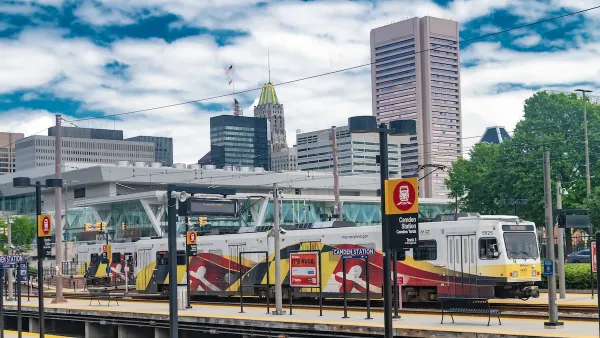
Feds Cancel Baltimore-to-DC High-Speed Rail Project
The Federal Railroad Administration cited concerns about disruptions to federally owned properties along the proposed HSR line, which would take passengers from Baltimore and D.C. in 15 minutes.

Planetizen Federal Action Tracker
A weekly monitor of how Trump’s orders and actions are impacting planners and planning in America.

California plans to bury El Niño’s downpour
If the state plays its cards right, it may be able to store a billion acre-feet of El Niño’s water in aquifers.

Desperate measures: Advocates weigh draining Lake Powell to fill Colorado River
Draining the reservoir could reduce evaporation losses by a couple hundred thousand acre-feet.

Los Angeles just elected an urban planner as its mayor
Transportation analysts are optimistic that Raman will be more aggressive in addressing transit issues than Bass.

Mamdani’s pied-à-terre tax survives legal challenge
A panel of judges found that the plaintiffs failed to demonstrate injury as a result of New York City's implementation of the tax.

Eastern Nebraska is running out of electricity
Data centers and electrification are straining eastern Nebraska’s grid, throttling economic development.

FREE Course: Walkable City 1: Why Walkability?
After describing his path towards focusing on walkability as the essence of good planning, Jeff Speck marches through his five principal reasons for making more walkable places.
Reinventing Malls: Planning Alchemy—Turning Gray Fields Into Gold
The course focuses on the opportunities and imperatives that shape reinvention of mall sites.

City of Rosemead
Rutgers University, Edward J. Bloustein School of Planning and Public Policy
One Hundred Miles
University of Michigan School for Environment and Sustainability (SEAS)
Hunter College, City University of New York (CUNY)
The Architects Foundation
City of Cambridge
Montrose County
The Pocatello Development Authority