The housing market -- and especially the exurban housing market -- played a major role in bringing about the current economic recession, according to this piece from Christopher Leinberger. He says sprawl is unlikely to regain its lost value.


The bailout of the housing and mortgage market has turned out to be much more expensive than the other bailouts. And as Leinberger writes in The New Republic, much more may be riding on the mortgage industry bailout.
"As reported on the front page of the Washington Post earlier this week, the Federal Reserve, the Treasury, and Fannie Mae and Freddie Mac have spent well over $1 trillion over the past year in propping up the securitized mortgage market and assuming untold risk of further mortgage defaults in the future. This is more than the bailout of the banks, AIG, and the car companies combined.
This mortgage bailout and the assumption of huge future risks were made in the hope that troubled housing, much of it on the fringe, will stabilize and regain its value. To some extent, it is a bet that sprawling development will recover its previously inflated value, a wager I'd decline."
Read the full story: Has Sprawl Recovered Enough for the National Economy?
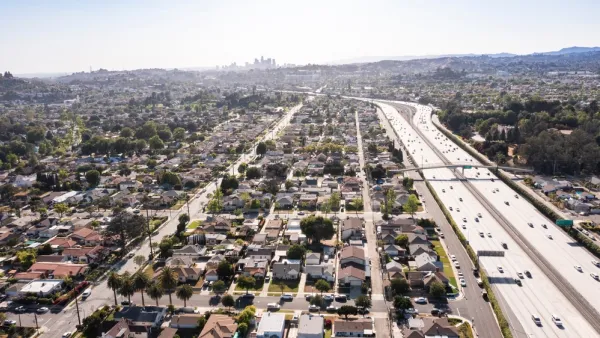
The Consequences of Sprawl: Overcrowded Housing and Covid Deaths
Los Angeles is the nation's capital of both crowding and sprawl. A feature published by the Los Angeles Times provides the history of how the metropolis achieved this contradiction.
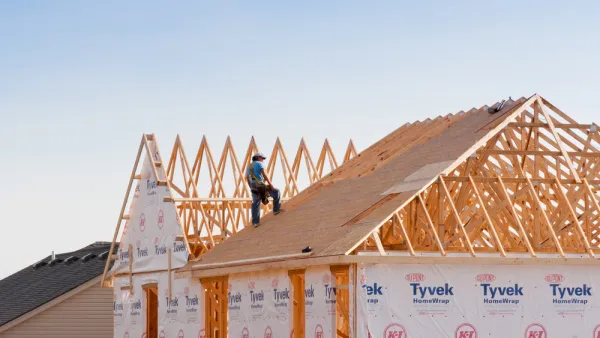
Single-Family Homes Appearing Faster Than Any Year Since 2006
The housing construction market is responding to strong demand with a glut of new single-family homes.
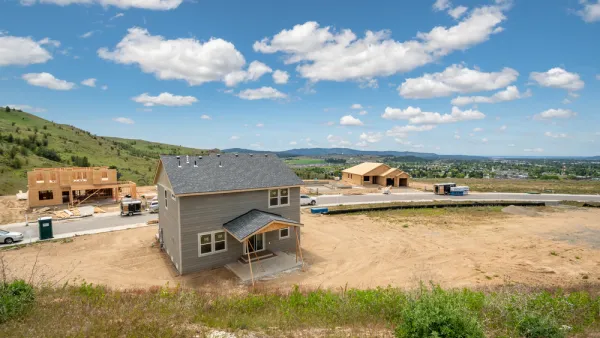
One-Third of Homes for Sale Are New, Report Says
New data from Redfin shows strong demand, and an increasing share of the supply, in new homes.

Planetizen Federal Action Tracker
A weekly monitor of how Trump’s orders and actions are impacting planners and planning in America.

Eastern Nebraska is running out of electricity
Data centers and electrification are straining eastern Nebraska’s grid, throttling economic development.

Study reveals best places in the U.S. for cycling, walking
New research from Streetlight Data examines bicycle and pedestrian miles per capita in the 100 largest U.S. cities by population.

Next-generation nuclear reactors are coming to Texas
The reactors will not require towering containment structures thanks to new safety features.

California distributes $1.3 billion to prevent transit service cuts, bolster projects
Twenty-eight projects across California received a portion of the funding.

Pennsylvania Democrats have 15 affordability, clean energy bills for flipped state Senate
Bills in consideration include a bill supporting geothermal energy and a bill supporting solar on warehouses.

FREE Course: Walkable City 1: Why Walkability?
After describing his path towards focusing on walkability as the essence of good planning, Jeff Speck marches through his five principal reasons for making more walkable places.
Reinventing Malls: Planning Alchemy—Turning Gray Fields Into Gold
The course focuses on the opportunities and imperatives that shape reinvention of mall sites.

City of Charlotte
City of Rosemead
Rutgers University, Edward J. Bloustein School of Planning and Public Policy
University of Michigan School for Environment and Sustainability (SEAS)
Hunter College, City University of New York (CUNY)
The Architects Foundation
City of Cambridge
The Pocatello Development Authority
The Urban Renewal Agency of the City of Pocatello