Groundbreaking for the nation's most technologically highway, a toll road, occurred on August 12 in North Carolina. Attended by Federal Highway Administrator Victor Mendez, the 19 mile road will have no toll booths. It is expected to open 2011.


The Triangle Expressway is not only unique from a technological perspective, but also from a financial basis as well. It relied on toll-revenue bonds, Build America bonds, and Transportation Infrastructure Finance and Innovation Act loans.
"This project will be designed and built to use an all-electronic system. There will be no toll booths and no stopping to pay tolls. Customers purchase a transponder that automatically charges for road use."
Don't have a transponder? Smile for the "overhead high-speed cameras (that) snap an image of your license plate and drivers will be billed according to the number of miles driven."
If successful, expect future tollways to use the same, all-electronic system technology.
Thanks to Charles Siegel
Read the full story: Federal Highway Administrator Mendez helps break ground on North Carolina's innovative Triangle Expressway

Nation's Newest Toll Road Opens in North Carolina
For a small fee, motorists can now bypass a congested arterial road with two dozen traffic lights outside of Charlotte. Built and operated by the North Carolina Turnpike Authority, the 18-mile, electronically tolled Monroe Expressway opened Nov. 27.

Singapore adopts in-vehicle GPS tech to manage road tolls
The city's latest update to its congestion pricing system could open the door to distance-based tolling.

Phantom Tollbooths: Caltrans to Remove Bay Area Bridge Toll Booths Defunct Since 2020
The Richmond-San Rafael Bridge will be the first in the Bay Area to eliminate toll booths entirely in favor of open-road tolling using sensors.

Planetizen Federal Action Tracker
A weekly monitor of how Trump’s orders and actions are impacting planners and planning in America.

Northwest rail fans eager for Sept. 30 debut of Amtrak’s Airo fleet
Get ready for that new train smell and more seats. But they won’t go faster or run more frequently on the Cascades route in Washington and Oregon.
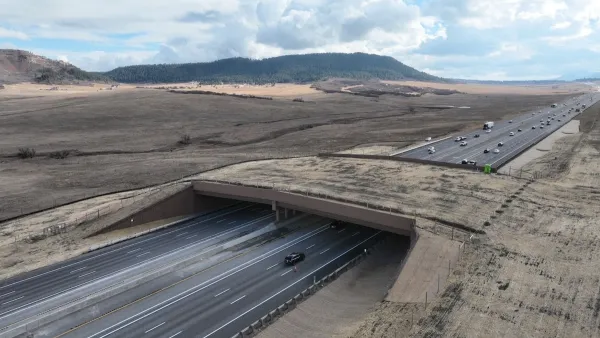
Record-breaking wildlife overpass in Colorado brings 91% reduction in animal collisions
Prior to the overpass, vehicles were hitting one deer per day on Colorado’s Interstate 25.

Detroit to transform waterfront with $2.2 billion investment
Developers will convert about 18 acres of unused parking lot space into civic spaces.

‘Going backwards:’ Baltimore mayor, students rally against state's transit funding plan
Maryland's proposed six-year plan provides no funding for Baltimore’s BMORE bus program and reduces its road maintenance funding.

Trump wants to cancel nearly 98% of funding for HUD housing support program
Multiple housing groups are suing the administration in an effort to preserve the funding.

FREE Course: Walkable City 1: Why Walkability?
After describing his path towards focusing on walkability as the essence of good planning, Jeff Speck marches through his five principal reasons for making more walkable places.
Reinventing Malls: Planning Alchemy—Turning Gray Fields Into Gold
The course focuses on the opportunities and imperatives that shape reinvention of mall sites.

City of Thousand Oaks
City of Wisconsin Rapids
Harvard University Graduate School of Design
The Architects Foundation
University of Cincinnati Online
Northern Illinois Transit Authority (NITA)
The Pocatello Development Authority
The Urban Renewal Agency of the City of Pocatello