In this column, former New York Governor Eliot Spitzer calls on the Obama Administration to direct its stimulus package towards innovative technologies and "transformative" projects, not just the status quo roads and bridges of the past.


"The 'off the shelf' infrastructure projects that can be funded immediately and provide immediate demand-side stimulus are almost by definition not the transformative investments we really need. Paving roads, repairing bridges that need refurbishing, and accelerating existing projects are all good and necessary, but not transformative. These projects by and large are building or patching the same economy with the same flaws that got us where we are. Our concern should be that as we look for the next great infrastructure project to transform our economy, we might rebuild the Erie Canal and find ourselves a century behind technologically."
"This moment presents the administration with what is likely to be its best-and perhaps only-opportunity to have essentially unlimited capital (both fiscal and political) to spend on a transformative economic agenda. It is a unique moment to build a new foundation. It would be wise to ensure that a significant portion of the stimulus package is spent on new investments that may not be quite as ready to go but are surely more important to our long-term economic viability."
Read the full story: Robots, Not Roads
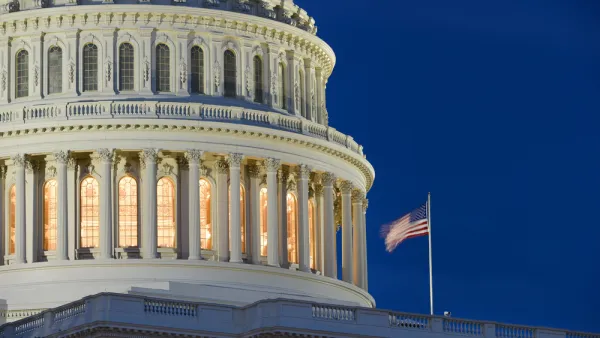
Historic 'Infrastructure Investment and Jobs Act' Passes Final Hurdle in Congress, Heads to Biden for Signature
Months after the Senate voted to approve the Infrastructure Investment and Jobs Act in a historic moment of bipartisan legislation, the House of Representatives put the finishing touches on a $1.2 trillion bill with $550 million in new spending.
Looking Back on the 5th Anniversary of the Federal Stimulus
The American Recovery and Reinvestment Act (ARRA) was signed into law on February 17, 2009, less than a month into President Obama's first term. The Council of Economic Advisers recently presented its final quarterly report on ARRA's impacts.
States Look to Claim Part of $69 Billion in Infrastructure Funds
The Obama Administration is set to announce a new jobs bill and state officials are clamoring to get their hands on some of the $69 billion the federal government is dedicating to the next batch of stimulus-related infrastructure projects.

Planetizen Federal Action Tracker
A weekly monitor of how Trump’s orders and actions are impacting planners and planning in America.

California plans to bury El Niño’s downpour
If the state plays its cards right, it may be able to store a billion acre-feet of El Niño’s water in aquifers.

Desperate measures: Advocates weigh draining Lake Powell to fill Colorado River
Draining the reservoir could reduce evaporation losses by a couple hundred thousand acre-feet.

Chicago voters approve permanent festival grounds, penalty for vacant property owners
Currently, major summer and fall festivals take over public parks for weeks at a time, drawing criticism from nearby residents

NYC votes to cut outdoor dining red tape, speed up permitting
New York City also voted to allow the Department of Transportation to begin work on urgent projects before notifying elected officials.

California appears to reject Prop. 45
The proposition would have expanded the projects that qualify for a streamlined environmental review, effectively paring down the California Environmental Quality Act.

FREE Course: Walkable City 1: Why Walkability?
After describing his path towards focusing on walkability as the essence of good planning, Jeff Speck marches through his five principal reasons for making more walkable places.
Reinventing Malls: Planning Alchemy—Turning Gray Fields Into Gold
The course focuses on the opportunities and imperatives that shape reinvention of mall sites.

City of Rosemead
Rutgers University, Edward J. Bloustein School of Planning and Public Policy
One Hundred Miles
Hunter College, City University of New York (CUNY)
The Architects Foundation
University of Cincinnati Online
City of Cambridge
Montrose County
The Pocatello Development Authority