Brooklyn residents have built a makeshift detour sign in an attempt to redirect drivers away from their street. A new bike lane was implemented in the fall that has removed stop signs and, according to residents, made their street unsafe.


"A new two-way bike lane was installed on Kent Avenue this past fall, accompanied by "No Stopping" signs, which have caused an uproar among community residents and businesses who lost a number of free curbside parking spaces and say the safety of their children is now at risk."
"'You cannot even drop off your kids. Buses are getting tickets. The deliveryman doesn't want to deliver, even my grocery delivery guy doesn't want to come,' says Kent Avenue resident Leo Moskowitz."
"'It's like living on a highway. It's less safe. Trucks are zooming like crazy. Kids can't play outside. People are very upset and talking about moving away,' he says."
"Several published reports have suggested the Kent Avenue dispute is rooted in a cultural clash between the Hasidic community that is dominant in the neighborhood and the 'hipsters' that dominate the bike lane, but Moskowitz says 'this is not a Hasidic fight, it's a community fight.'"
Read the full story: Brooklyn Bike Lane Controversy Continues

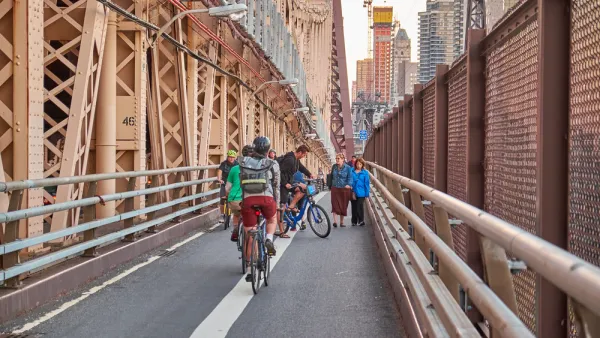
Bike-Centered Brooklyn Bridge Redo Under Consideration
City officials in New York are discussing the possibility of converting a car traffic lane on the Brooklyn Bridge for use by people on bikes.
Study: Bike Lanes Raise Property Values in Brooklyn
New bike lanes in the Brooklyn neighborhood of Bushwick started raising property values within a year.
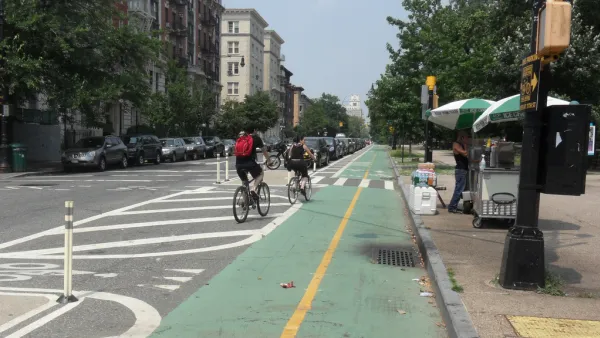
Got Protected Bike Lanes?
While Angie Schmitt doesn't ask this question in her article on the movement behind these lanes, she writes that cities without them "are being left behind". They're popular because they effectively address the #1 reason for not riding: safety

Planetizen Federal Action Tracker
A weekly monitor of how Trump’s orders and actions are impacting planners and planning in America.

The state-sanctioned urbicide of Austin
People don’t kill cities. Freeways do.

US to reduce Colorado River water deliveries to Mexico
A new Colorado Treaty amendment reduces Mexico’s Colorado River water allocation by 250,000 acre feet.

Nation's most wind-powered state turns to coal as data centers increase energy demand
For the first time in decades, Iowa has increased its generation of coal power.

NYC cools commuters with city's first rain garden above a bus stop
New York City officials say the plants in the rain garden can absorb 16 gallons of rainwater during heavy storms.

Brightline West’s future may rely on $6 billion federal loan
The company has until Nov. 2 to make a $400 million equity investment into its proposed high-speed rail line.

FREE Course: Walkable City 1: Why Walkability?
After describing his path towards focusing on walkability as the essence of good planning, Jeff Speck marches through his five principal reasons for making more walkable places.
Reinventing Malls: Planning Alchemy—Turning Gray Fields Into Gold
The course focuses on the opportunities and imperatives that shape reinvention of mall sites.

Greater Baltimore Committee
Eagle County Government
Harvard University Graduate School of Design
The Architects Foundation
University of Cincinnati Online
The Pocatello Development Authority
The Urban Renewal Agency of the City of Pocatello
Journal of the American Planning Association