Montana is flush with wind power capacity and the state's governor wants $15 billion in federal funding to build the infrastructure to transmit it. But some worry the proposed grid would also expand coal-based energy production.


"The interior West's abundance of both green-energy resources and traditional fossil fuels make some watchdogs nervous about a rush to build what has been called an Interstate highway system for electrons. The idea of expanding transmission lines is commonly pitched by politicians as a way to put people to work while removing a crucial obstacle to renewable power."
"But it's not going to be just wind and sun on those wires. '[S]ome proponents of expanding coal-fired electricity production are using windfarms as a rationalization for greatly expanding transmission lines through the region.'"
"'They talk a lot about wind power, but their real interest is vastly expanded use of coal in generating electricity,' says Larry Swanson, a regional economist at the O'Connor Center for the Rocky Mountain West at the University of Montana in Missoula."
"Schweitzer does not deny that federally funded transmission lines would also help his state's coal industry. He says he is a strong advocate not just for renewables but for so-called clean coal technologies."
Read the full story: Montana’s got wind, needs power lines
Combining Infrastructures
A team of French designers are the winners of Metropolis’s 2009 Next Generation competition with their design for a combined electrical-transmission tower and landfill.
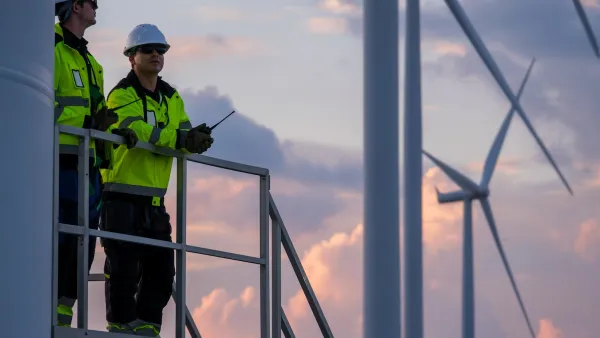
Despite court ruling, Trump is keeping nearly all wind projects in the US on hold
At least 110 wind energy projects have not heard from the government since a federal judge ruled that the Trump administration's freeze on wind turbine clearances was likely illegal.
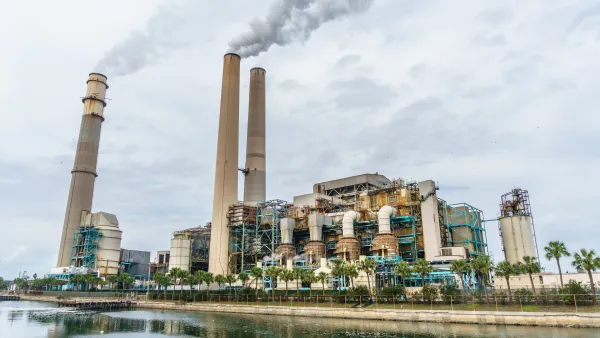
EPA to slash water treatment requirements for coal plants, citing growing electricity demand from AI data centers
The agency says the revisions to wastewater regulations — which critics call dangerous to human health — will decrease energy production costs by $1.1 billion annually.

Planetizen Federal Action Tracker
A weekly monitor of how Trump’s orders and actions are impacting planners and planning in America.

California plans to bury El Niño’s downpour
If the state plays its cards right, it may be able to store a billion acre-feet of El Niño’s water in aquifers.

Desperate measures: Advocates weigh draining Lake Powell to fill Colorado River
Draining the reservoir could reduce evaporation losses by a couple hundred thousand acre-feet.

Chicago voters approve permanent festival grounds, penalty for vacant property owners
Currently, major summer and fall festivals take over public parks for weeks at a time, drawing criticism from nearby residents

NYC votes to cut outdoor dining red tape, speed up permitting
New York City also voted to allow the Department of Transportation to begin work on urgent projects before notifying elected officials.

California appears to reject Prop. 45
The proposition would have expanded the projects that qualify for a streamlined environmental review, effectively paring down the California Environmental Quality Act.

FREE Course: Walkable City 1: Why Walkability?
After describing his path towards focusing on walkability as the essence of good planning, Jeff Speck marches through his five principal reasons for making more walkable places.
Reinventing Malls: Planning Alchemy—Turning Gray Fields Into Gold
The course focuses on the opportunities and imperatives that shape reinvention of mall sites.

City of Rosemead
Rutgers University, Edward J. Bloustein School of Planning and Public Policy
One Hundred Miles
Hunter College, City University of New York (CUNY)
The Architects Foundation
University of Cincinnati Online
City of Cambridge
Montrose County
The Pocatello Development Authority