In this op-ed, "San Francisco is not London", Steve Falk, the CEO of the S.F. Chamber of Commerce, explains why London-style congestion pricing is inappropriate for the downtown core - that it would only hurt businesses without reducing congestion.


"There is no doubt that San Francisco's freeways, access ramps and surface streets are congested during peak periods, but charging fees to drive downtown will do little to untangle the snarl. Why?
Because most city congestion is caused by heavy regional traffic leading to and from bridges and freeways, not by drivers heading downtown. Imposing a fee to drive downtown will only hurt San Francisco businesses and residents as has happened in Central London."
Falk cites figures showing that businesses have fled London's dowtown only to relocate outside the 'zone'.
As for the tolls charged, "half the money raised is used to collect and enforce the fee, thus a new well-funded bureaucracy has been born, with little to show for its mission."
"We need solutions to reducing the regional traffic other than imposing a congestion fee. Incentives to use regional and in-city public transit, or to drive into the city on off-peak hours, would do more to ease congestion."
Thanks to MTC-ABAG_Library
Read the full story: San Francisco is not London

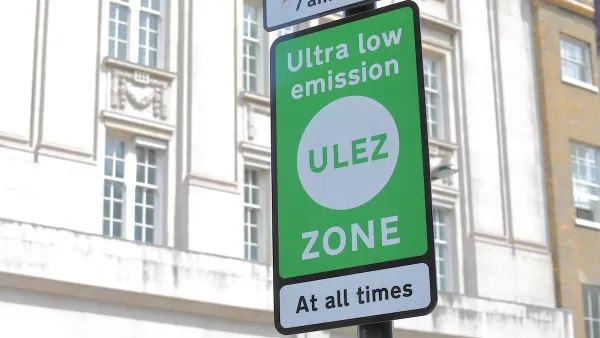
Study: London ULEZ Rapidly Cleaning up Air Pollution
Expanding the city’s ultra low-emission zone has resulted in dramatic drops in particle emissions in inner and outer London.
London Congestion Pricing Zone Has No Impact on Local Spending
The city’s cordon pricing scheme did not affect how much people spent at local businesses, new research finds.
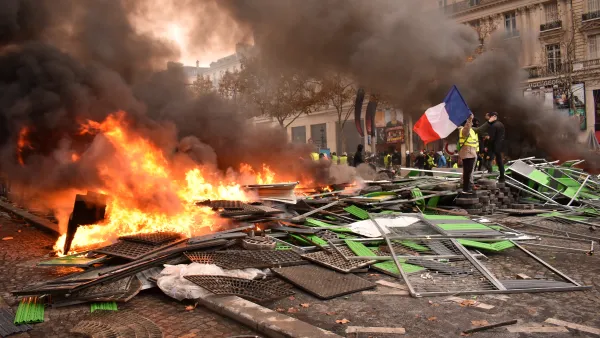
Watch Out for Green Class Backlash
Low emission zones, like that implemented in London, face backlash from critics on all sides of the political spectrum for impacting the poorest drivers and putting a burden on small businesses.

Planetizen Federal Action Tracker
A weekly monitor of how Trump’s orders and actions are impacting planners and planning in America.

Amtrak, CN end decades-long dispute with eight-year agreement
The new operating agreement establishes an updated framework for the companies to work together, including processes to resolve disputes.

Judges permit Denver to divert 77,000 acre feet from the Colorado River for reservoir expansion
Overuse and climate change have caused the Colorado River’s water levels to plummet.

Boston has spent millions making the Green Line more accessible — and there’s no end in sight
While the city has invested millions into expanding and adding platforms to the Green Line to make it more accessible, new train cars set to arrive next year will be too tall for disabled passengers to board without raising the current platforms.

Idaho may see an 18% drop in federal surface transit funding — the largest estimated cut in the US
Transit systems in rural communities are much more reliant on federal funding to provide their services.

How ‘post-disaster gentrification’ alters neighborhoods after natural calamities
After hurricanes, fires or other calamities, the original residents of a community are often replaced by younger, wealthier residents.

FREE Course: Walkable City 1: Why Walkability?
After describing his path towards focusing on walkability as the essence of good planning, Jeff Speck marches through his five principal reasons for making more walkable places.
Reinventing Malls: Planning Alchemy—Turning Gray Fields Into Gold
The course focuses on the opportunities and imperatives that shape reinvention of mall sites.

City of Wisconsin Rapids
Harvard University Graduate School of Design
KFH Group Inc.
The Architects Foundation
University of Cincinnati Online
The Pocatello Development Authority
The Urban Renewal Agency of the City of Pocatello