The L.A. County Board of Supervisors recently approved a package of green building ordinances that may be the most comprehensive and far reaching green building legislation at the local level in the country.


The article features an interview with Los Angeles County Supervisor Zev Yaroslavsky:
"What we've done is a bit more comprehensive than what the state has done. We're looking not only at the design of buildings and how to make buildings more energy efficient, but also at ground water recharge, and low impact development standards that are the most far reaching adopted by any local jurisdiction in the state."
"In the end, everybody understood that this was where the county was moving. The county and the Board of Supervisors communicated clearly that we were going to move in this direction. Doing nothing, or doing something meaningless, was not an option. The Building Industry Association was convinced of that. Heal the Bay understood that we were going to advance the ball a considerable distance down the field."
"It surely marks a change in the conditions we impose on new developments. There is a growing consensus in the county family, starting with the Board of Supervisors, that if there is going to be development, this is how it should take place. We can do it the right way or the wrong way."
Read the full story: L.A. County Passes ‘Landmark’ Green Building Ordinance
New Tool Adds Transportation to the Green Building Equation
A new free online tool, developed by the Center for Neighborhood Technology for the US Green Building Council, adds the effect of transportation and indirect emissions to the sustainable building equation.
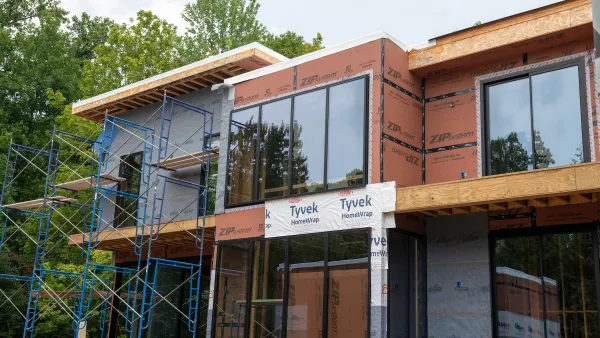
New HUD guidelines call for nixing green building requirements
The newly released 'best practices' advise local governments to streamline permitting processes, cap permitting fees and encourage by-right development of single-family homes.

Milwaukee can now Impound Cars of Reckless Drivers
The city compares reckless drivers to firearms — “Let’s get as many of them off the street as possible.”

Planetizen Federal Action Tracker
A weekly monitor of how Trump’s orders and actions are impacting planners and planning in America.

Washington state to charge fee to drivers with fuel-efficient cars
Revenue from the fee will go towards supporting the state’s highways.

Trump to blast ‘hydrocarbon highway’ through ‘world’s longest art gallery’
Environmental and historic preservation groups are suing to stop the project.

Data centers need power – lower income, rural residents pay the price
In 2025, data centers paid only 38% of the energy infrastructure costs linked to their growth, with households, especially rural and low-income residents, bearing the remaining burden.

MBTA Green Line project moved to next phrase of CIG program
The modernization effort will cost $4.08 billion.

22-mile pedestrian and bike path to encircle Atlanta by 2030
The project will also support affordable housing.

FREE Course: Walkable City 1: Why Walkability?
After describing his path towards focusing on walkability as the essence of good planning, Jeff Speck marches through his five principal reasons for making more walkable places.
Reinventing Malls: Planning Alchemy—Turning Gray Fields Into Gold
The course focuses on the opportunities and imperatives that shape reinvention of mall sites.

City of Charlotte
City of Rosemead
Rutgers University, Edward J. Bloustein School of Planning and Public Policy
University of Michigan School for Environment and Sustainability (SEAS)
Hunter College, City University of New York (CUNY)
The Architects Foundation
University District Partnership