Preservationists say that there are better ways to use buildings along Brooklyn's industrial waterfront than to demolish them.


"'Demolition is incredibly wasteful,' [Lisa Kersavage, the director of advocacy and policy at the Municipal Art Society] said. 'In New York City, 60 percent of our waste stream is demolition and construction debris which is significantly higher than the rest of the country, and we have to ship our demolition debris to other mid-Atlantic states.'
Andrew H. Kimball, the president and chief executive of the Brooklyn Navy Yard Development Corporation, talked about job creation in the 300-acre Navy Yard between the Manhattan and Williamsburg bridges, which at its peak employed some 70,000 workers. In the last seven years, 2,000 jobs have been created in the former navy complex - where ships like the Maine, the Missouri and the Arizona were built – is now home to artists and furniture makers, entertainment companies, green and light manufacturing companies."
"Industrial jobs pay 25 to 30 percent more than service sector jobs. 'This stabilizes our community,' he said. 'Obviously we've got to continue to not rely as much as we do today on Wall Street.'"
Read the full story: Preserving New York’s Industrial Past


Former Brooklyn Sugar Refinery Reopens as All-Electric Office Tower
A historic building was reimagined as a 15-story office tower powered by renewable energy.
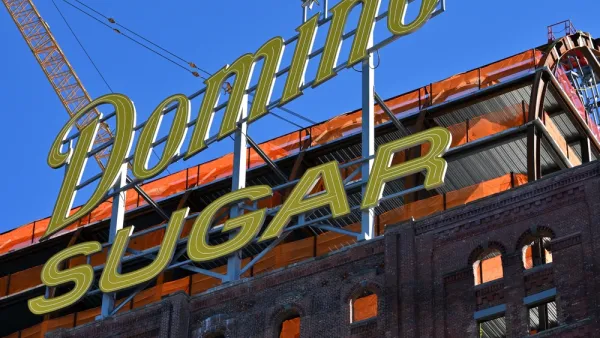
Bitter Irony Behind Brooklyn’s Sweet Domino Sugar Sign
A new feature on the Brooklyn waterfront is a reminder that Domino Sugar has made several unsavory appearances in the history of Puerto Rican communities.
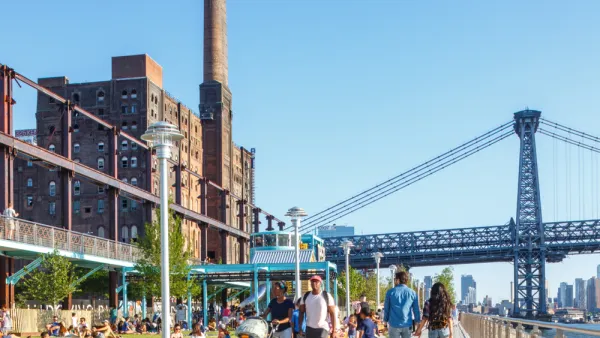
Field Operations-Designed Domino Park In Brooklyn Reviewed
The long-anticipated Domino Park, located in front of the former Domino Sugar refinery on the East River in Brooklyn, was designed by James Corner Field Operations (JFCO).

Planetizen Federal Action Tracker
A weekly monitor of how Trump’s orders and actions are impacting planners and planning in America.

Chicago breaks ground on $3 billion megadevelopment
The new neighborhood, titled Foundry Park, will one day host 3,700 residences.

This MA town is drowning in its own sewage — and residents like it that way
Susan Murcott, a waste water expert, said if Carlisle didn't address their leaking sewage, the problem could turn “deadly.”

Feds to more closely scrutinize proposed Amtrak facility’s environmental impact
The Federal Railroad Administration had initially said the facility qualified for a less extensive environmental review.

Boston is hard to build housing in: its chief of planning wants to keep it that way
Chief of Planning Kairos Shen said she would not make changes to Boston’s affordability requirements for new housing, which critics say have slowed down development.

California plans to bury El Niño’s downpour
If the state plays its cards right, it may be able to store a billion acre-feet of El Niño’s water in aquifers.

FREE Course: Walkable City 1: Why Walkability?
After describing his path towards focusing on walkability as the essence of good planning, Jeff Speck marches through his five principal reasons for making more walkable places.
Reinventing Malls: Planning Alchemy—Turning Gray Fields Into Gold
The course focuses on the opportunities and imperatives that shape reinvention of mall sites.

City of Rosemead
Rutgers University, Edward J. Bloustein School of Planning and Public Policy
One Hundred Miles
Hunter College, City University of New York (CUNY)
The Architects Foundation
University of Cincinnati Online
Montrose County
The Pocatello Development Authority
The Urban Renewal Agency of the City of Pocatello