Olafur Eliasson’s "Waterfalls" public art installations around New York Harbor's waterfront generated an estimated economic impact of $69 million, exceeding the initial estimate of $55 million.


"The work, commissioned by the Public Art Fund and presented in collaboration with the city, was the city's most ambitious public art project since 'The Gates,' the February 2005 installation by Christo and Jeanne-Claude, who festooned Central Park with saffron-colored fabric.
And yet, the 'Waterfalls' were not unquestionably good."
"'We always knew the Waterfalls was going to reinvigorate our City's waterfront - but its actual impact has exceeded our expectations,' Mr. Bloomberg said at a news conference at the Public School 1 Contemporary Art Center in Long Island City, Queens, where he was joined by other officials and by Mr. Eliasson. 'People didn't buy tickets or pass through a turnstile to experience the Waterfalls, but this exhibition brought people to areas of the city they might not otherwise ever have visited. We've always understood that we have to encourage big, bold projects that set our City apart, and this will be increasingly important while areas of our economy are struggling from the turmoil on Wall Street.'"
Thanks to rob bregoff
Read the full story: City Puts ‘Waterfalls’ Impact at $69 Million

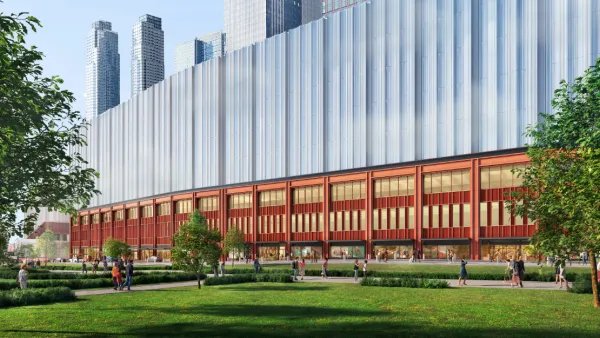
A sneak peek at NYC’s Midtown Bus Terminal rebuild
The city will turn a deck used for storage during the construction process into a park once construction is complete.
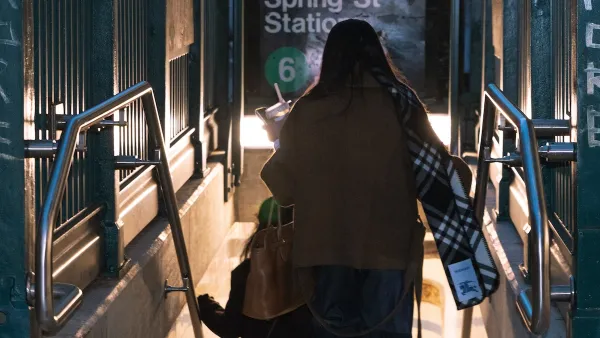
MTA kicks off six-year, $1 billion transit upgrade project
The authority is replacing the roughly 90-year-old train signals on the A and C line with modern technology.

Learning loss and urban schools, part 2
Did test scores in progressive cities drop more post-COVID than test scores in moderate ones?

Planetizen Federal Action Tracker
A weekly monitor of how Trump’s orders and actions are impacting planners and planning in America.

Chicago breaks ground on $3 billion megadevelopment
The new neighborhood, titled Foundry Park, will one day host 3,700 residences.

This MA town is drowning in its own sewage — and residents like it that way
Susan Murcott, a waste water expert, said if Carlisle didn't address their leaking sewage, the problem could turn “deadly.”

Feds to more closely scrutinize proposed Amtrak facility’s environmental impact
The Federal Railroad Administration had initially said the facility qualified for a less extensive environmental review.

Boston is hard to build housing in: its chief of planning wants to keep it that way
Chief of Planning Kairos Shen said she would not make changes to Boston’s affordability requirements for new housing, which critics say have slowed down development.

California plans to bury El Niño’s downpour
If the state plays its cards right, it may be able to store a billion acre-feet of El Niño’s water in aquifers.

FREE Course: Walkable City 1: Why Walkability?
After describing his path towards focusing on walkability as the essence of good planning, Jeff Speck marches through his five principal reasons for making more walkable places.
Reinventing Malls: Planning Alchemy—Turning Gray Fields Into Gold
The course focuses on the opportunities and imperatives that shape reinvention of mall sites.

City of Rosemead
Rutgers University, Edward J. Bloustein School of Planning and Public Policy
One Hundred Miles
Hunter College, City University of New York (CUNY)
The Architects Foundation
University of Cincinnati Online
Montrose County
The Pocatello Development Authority
The Urban Renewal Agency of the City of Pocatello