Changes proposed in a recently approved five-year plan would resolve a nearly century-old snarl that routinely delays trains.


New York City’s Metropolitan Transportation Authority plans to resolve a decades-old bottleneck in its subway system, reports Stephen Nessen in Gothamist.
“It’s called the Nostrand Interlocking, and all who pass through it are familiar with its wrath. The interlocking is located in the stretch of Central Brooklyn where the 2, 3, 4 and 5 lines intersect, and requires dozens of trains to grind to a halt every hour.” As Nessen explains, the section causes significant delays.
Now, the MTA “aims to reconfigure service to reduce the number of conflicts at the interchange by essentially swapping the 3 and 5 routes east of Franklin Avenue. Instead of turning down Nostrand Avenue, 5 trains would run beneath Eastern Parkway. And instead of intersecting with incoming trains to travel along Eastern Parkway, 3 trains would turn down Nostrand Avenue.”
The plan, which is part of the recently approved, $65 billion five-year capital plan, would require the construction of a new crossover track. “The agency currently has no hard timeline for fixing the bottleneck, but plans to move forward with the work in the coming years.”
FULL STORY: MTA plans to untangle one of NYC's worst subway bottlenecks

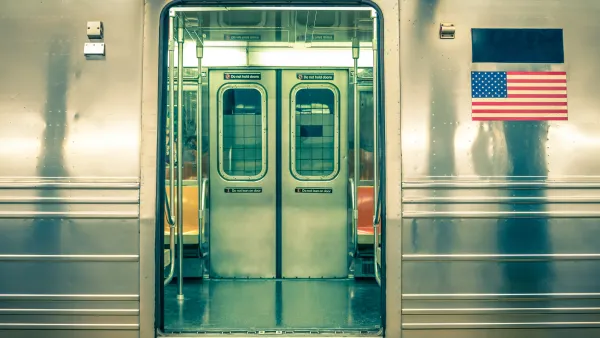
MTA Boosts Suicide Prevention Efforts on Subway System
One pilot program involves installing blue lights that could have a ‘calming effect’ at three subway stations.
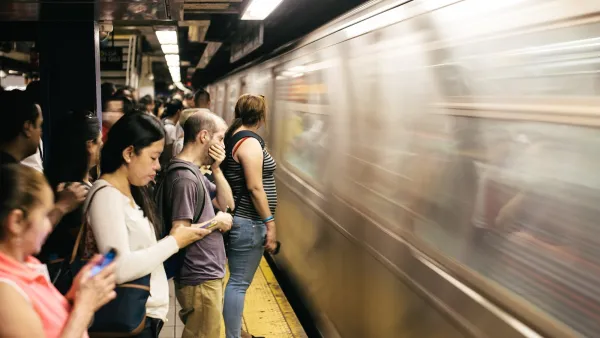
New York Subway Will Pilot Platform Barriers To Improve Rider Safety
After a shocking death and an overall rise in violent crime at its stations, New York City's transit authority will install platform barriers to prevent intentional or accidental falls onto tracks.
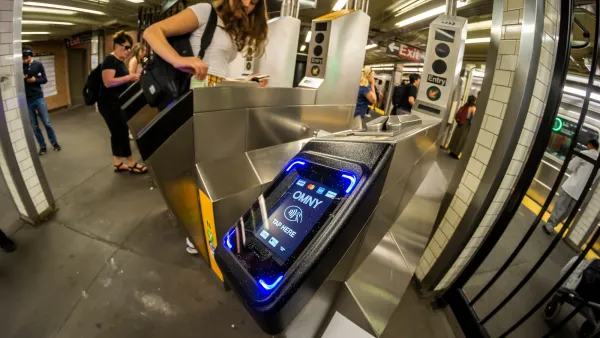
Popular transit payment system linked to Palantir could give ICE access to rider data
The tap-to-pay system is being used widely in transit systems including New York City, Boston and Chicago.

Planetizen Federal Action Tracker
A weekly monitor of how Trump’s orders and actions are impacting planners and planning in America.

The state-sanctioned urbicide of Austin
People don’t kill cities. Freeways do.

US to reduce Colorado River water deliveries to Mexico
A new Colorado Treaty amendment reduces Mexico’s Colorado River water allocation by 250,000 acre feet.

5 New England states march closer to 800 megawatt wind energy project
Securing federal approval for the project may be complicated under the Trump administration, which has historically been hostile towards domestic wind power.

Baltimore to break ground on $50 million Transit Priority Project
The project will bring faster bus trips, safer streets and better bike connections to Baltimore.

Airbnb launches $250 million 'last-dollar financing' housing accelerator, makes first investment in Austin
The company will put $6.4 million towards affordable housing development in Texas’ capital.

FREE Course: Walkable City 1: Why Walkability?
After describing his path towards focusing on walkability as the essence of good planning, Jeff Speck marches through his five principal reasons for making more walkable places.
Reinventing Malls: Planning Alchemy—Turning Gray Fields Into Gold
The course focuses on the opportunities and imperatives that shape reinvention of mall sites.

.jpg)
Eagle County Government
Harvard University Graduate School of Design
Nashville Planning Department
The Architects Foundation
University of Cincinnati Online
The Pocatello Development Authority
The Urban Renewal Agency of the City of Pocatello
Journal of the American Planning Association