This article from USA Today looks at how some big cities are reacting to rising energy prices. Two examples from metropolitan Phoenix highlight the fact that it is not only suburbs that are being forced to respond.


"Outlying suburbs aren't the only places rethinking growth and development patterns amid mushrooming costs of gasoline and other energy sources."
"Building on a movement in the 1990s that invigorated many downtowns, urban centers and adjoining communities are forging ahead with redevelopment projects to attract residents."
"Phoenix native Michael Hallmark, architect of the Staples Center arena in Los Angeles, Safeco Field in Seattle and other large venues, was part of an ambitious effort to bring sports and entertainment back to downtown Phoenix. He's helping plan the city's Jackson Street Entertainment District, which will make a neighborhood denser."
"He is narrowing streets and bringing in entertainment spots, stores, restaurants and condos. The district will tie in to Phoenix's new light-rail system, Arizona State University's downtown campus and the convention center. It follows "green" standards by developing under-utilized land, maximizing shade and reducing water runoff."
FULL STORY: Like suburbs, large cities are rethinking growth patterns

The Presidential Focus on Cities and Metros
Urban policy is looking to be a major element of President Barack Obama's administration. Though it hasn't quite taken shape yet, this piece argues it's a good sign for cities and metropolitan regions.
15 US cities and their global namesakes
Hundreds of cities around the United States are named after other places. We tour a few of them.
New study visualizes how city shapes impact mobility
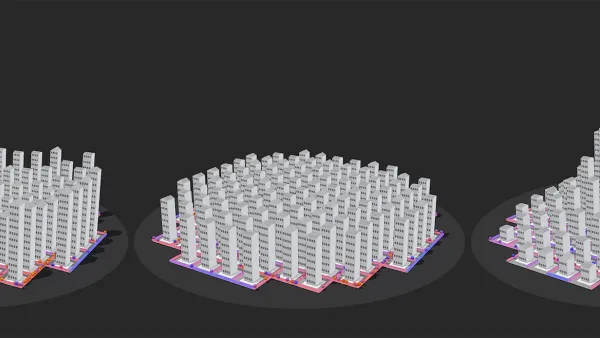
Whether circular or linear, the shape and layout of cities affects how their residents get around.

Planetizen Federal Action Tracker
A weekly monitor of how Trump’s orders and actions are impacting planners and planning in America.

The state-sanctioned urbicide of Austin
People don’t kill cities. Freeways do.

US to reduce Colorado River water deliveries to Mexico
A new Colorado Treaty amendment reduces Mexico’s Colorado River water allocation by 250,000 acre feet.

Brightline West’s future may rely on $6 billion federal loan
The company has until Nov. 2 to make a $400 million equity investment into its proposed high-speed rail line.

LA Metro’s ultimatum: no extra buses for LA28 if federal funding isn’t imminently secured
If Metro does not provide additional buses, LA28 organizers will have to find a new way to manage Olympic traffic. LA28’s budget does not include a line item for transit.

Colorado’s Largest Data Center Could Rise Next to Homes — Without a Public Hearing
The proposed campus would consume 11 times the power of Denver International Airport; as it has across the country, opposition mounts.

FREE Course: Walkable City 1: Why Walkability?
After describing his path towards focusing on walkability as the essence of good planning, Jeff Speck marches through his five principal reasons for making more walkable places.
Reinventing Malls: Planning Alchemy—Turning Gray Fields Into Gold
The course focuses on the opportunities and imperatives that shape reinvention of mall sites.

Eagle County Government
Harvard University Graduate School of Design
Nashville Planning Department
The Architects Foundation
University of Cincinnati Online
The Pocatello Development Authority
The Urban Renewal Agency of the City of Pocatello
Journal of the American Planning Association