New York Times architecture critic Nicolai Ouroussoff discusses why the impending breakdown of the Atlantic Yards project in Brooklyn is a harsh blow to urban planning in New York.


"The growing possibility that much of the multibillion-dollar Atlantic Yards development in Brooklyn will be scrapped because of a lack of financing may be a bitter pill for its developer, Forest City Ratner. But it's also a painful setback for urban planning in New York."
"When it was unveiled in late 2003, it seemed to signal a genuine effort to raise the quality of large-scale development in a city still stinging from the planning failures at ground zero."
"So if the decision to proceed with an 18,000-seat basketball arena but to defer or eliminate the four surrounding towers is defensible from a business perspective, it also feels like a betrayal of the public trust."
"It's important to remember that this is also the city that spawned Rockefeller Center, a 22-acre development at the core of Manhattan that became a glorious emblem of the 20th-century metropolis. For some of us Atlantic Yards presented a creative opportunity for the 21st century."
"If large-scale development is unavoidable, why not enlist serious talents like Mr. Gehry to come up with an alternative to the bottom-line proposals that have been the accepted norm for decades? Finally a big developer had turned to a legitimate architectural hero for help, rather than the usual corporate hacks."
Read the full story: What Will Be Left of Gehry’s Vision for Brooklyn?


Opinion: It's Time to Rezone Gowanus
As the New York City Council considers a controversial plan for the Gowanus neighborhood in Brooklyn, Moses Gates calls on the city to pass "one of the best and most inclusive community planning processes in recent times."
Planning via Zoom: Legal Scrutiny for Pandemic Realities in New York City
The question of whether a public review process conducted by Zoom is sufficient to approve a sweeping rezoning plan is a matter of no small legal concern in New York City.
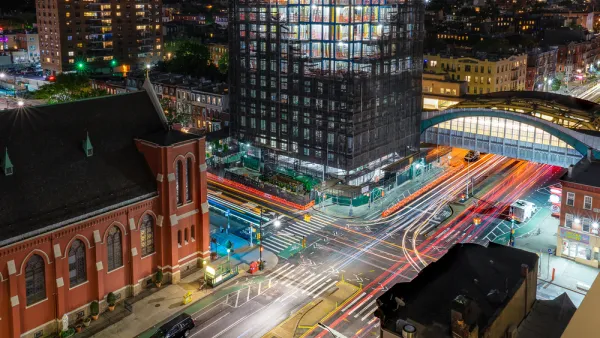
Lawsuit Challenges Zoom Hearings on Gowanus Rezoning Plan
Planning departments relying on online public hearing processes will want to keep monitor this lawsuit in New York City.

Planetizen Federal Action Tracker
A weekly monitor of how Trump’s orders and actions are impacting planners and planning in America.

Amtrak, CN end decades-long dispute with eight-year agreement
The new operating agreement establishes an updated framework for the companies to work together, including processes to resolve disputes.

Judges permit Denver to divert 77,000 acre feet from the Colorado River for reservoir expansion
Overuse and climate change have caused the Colorado River’s water levels to plummet.

NYC DOT wants faster, more permanent street upgrades
The city is examining ways to build more concrete infrastructure without getting entangled in 'decades-long' projects.

'Something we’ve never seen before:' rising utility rates could strain city finances nationwide
Data centers, climate change and other factors have caused utility rates in the United States to increase by 38% since 2020.

Trump to overrule local leaders, lease millions of acres of America’s Pacific Island territories’ seafloors to mining companies
International law says that the Indigenous people of America’s territories have a right to prior and informed consent regarding projects that impact their countries.

FREE Course: Walkable City 1: Why Walkability?
After describing his path towards focusing on walkability as the essence of good planning, Jeff Speck marches through his five principal reasons for making more walkable places.
Reinventing Malls: Planning Alchemy—Turning Gray Fields Into Gold
The course focuses on the opportunities and imperatives that shape reinvention of mall sites.

Harvard University Graduate School of Design
KFH Group Inc.
Greater Baltimore Committee
The Architects Foundation
University of Cincinnati Online
The Pocatello Development Authority
The Urban Renewal Agency of the City of Pocatello