With increasing congestion and freeways built out just about as far as they can go, transportation planners in the San Francisco Bay Area are considering plans to put on-ramp metering lights on many of the area's most congested stretches of freeway.


"In an age when building or widening freeways isn't possible or is prohibitively expensive, ramp metering lights are increasingly seen as the path to relieving traffic congestion."
"That's especially true on the Bay Area's most-congested stretch of freeway, Interstate 80 from Hercules to the Bay Bridge Toll Plaza. Traffic engineers are planning to make the on-again, off-again traffic signals the linchpin of an $88 million plan to squeeze the maximum efficiency out of the interstate, which can't be widened without destroying the swath of civilization built up against its noise barriers."
"But even 45 years after the first ramp metering was tested by police officers waving traffic onto Chicago's Eisenhower Expressway, some Bay Area officials are still skittish about impeding freeway access."
"'It's been kind of an uphill struggle in the Bay Area,' said Albert Yee, director of Highway and Arterial Operations for the Metropolitan Transportation Commission. While the commission is attempting to promote and finance a $600 million area-wide system favoring more metering lights to help move traffic more efficiently, some officials in Contra Costa have resisted the effort."
FULL STORY: Freeway plan gets traction

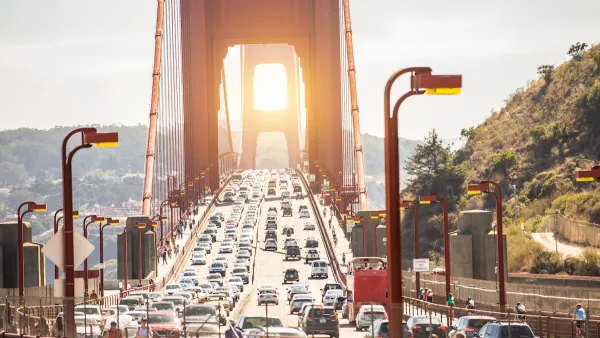
San Francisco ‘Best-Performing Metro’ for VMT, Traffic Reduction
The city saw a 13 percent drop in miles driven per capita in the last five years.
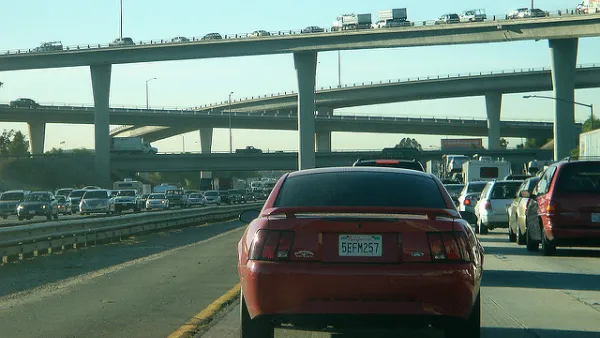
If You Build It, Cars Will Come: the Common-Sense Logic of 'Induced Demand'
Highway expansion has been shown, time and again, to increase traffic and congestion. Cities are finally getting the message.
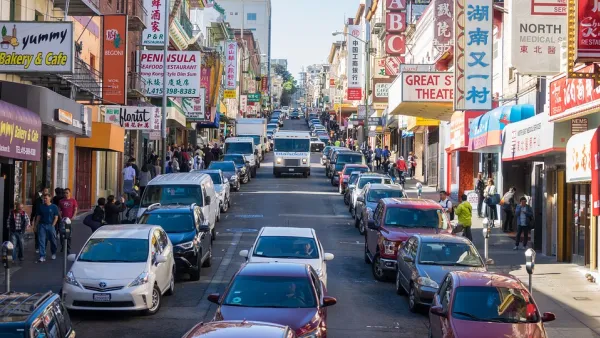
Congestion Pricing Scheme Up for Discussion in San Francisco
The public is providing feedback for the idea of a congestion pricing scheme that could charge as much as $12 to drive into Downtown San Francisco.

Planetizen Federal Action Tracker
A weekly monitor of how Trump’s orders and actions are impacting planners and planning in America.

The state-sanctioned urbicide of Austin
People don’t kill cities. Freeways do.

US to reduce Colorado River water deliveries to Mexico
A new Colorado Treaty amendment reduces Mexico’s Colorado River water allocation by 250,000 acre feet.

5 New England states march closer to 800 megawatt wind energy project
Securing federal approval for the project may be complicated under the Trump administration, which has historically been hostile towards domestic wind power.

Baltimore to break ground on $50 million Transit Priority Project
The project will bring faster bus trips, safer streets and better bike connections to Baltimore.

Airbnb launches $250 million 'last-dollar financing' housing accelerator, makes first investment in Austin
The company will put $6.4 million towards affordable housing development in Texas’ capital.

FREE Course: Walkable City 1: Why Walkability?
After describing his path towards focusing on walkability as the essence of good planning, Jeff Speck marches through his five principal reasons for making more walkable places.
Reinventing Malls: Planning Alchemy—Turning Gray Fields Into Gold
The course focuses on the opportunities and imperatives that shape reinvention of mall sites.

Eagle County Government
Harvard University Graduate School of Design
Nashville Planning Department
The Architects Foundation
University of Cincinnati Online
The Pocatello Development Authority
The Urban Renewal Agency of the City of Pocatello
Journal of the American Planning Association