This editorial from The Washington Post argues that re-planning the Washington D.C.-Dulles International Airport corridor for buses rather than trains is an idea that just won't work.


"Within the next few weeks, the U.S. Transportation Department will make a final decision on whether to approve federal funding for the Dulles corridor Metrorail extension [Metro, Feb. 16]. This project has been in the planning phase for more than 40 years. It is time to stop talking about this project and start building it."
"In January, the National Surface Transportation Policy and Revenue Study Commission released a report on the need for rail rapid transit in large urban areas. As a commissioner of the study, it was clear to me that there is a great need for mass transit to meet the transportation requirements of the future. The Dulles corridor is one of the most congested areas in the United States. Tysons Corner is the largest employment center in Virginia, with more than 100,000 workers. Dulles International Airport serves about 25 million passengers a year; that number is expected to double once renovations there are completed."
Read the full story: Taking the Bus Is Not an Option
D.C. Airport-Rail Link Heading to Congress
Plans to expand rail transit to link Washington D.C with Dulles International Airport have received federal backing and can now head to Congress for funding approval.
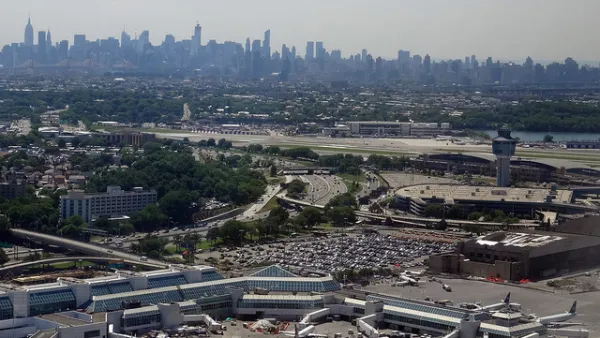
$32 Billion for Port Authority Capital Plan
A plan that includes improvements for LaGuardia, new rail transit and more automotive infrastructure to be completed over the next ten years.
Planes, Trains, and Tourists; Why Can't California Connect the Dots?
Why can't California make it easier for its millions of visitors, and residents, to travel from airports to urban centers via direct rail routes? The state is investing billions in its rail and air infrastructure, but can't seem to connect the two.

Planetizen Federal Action Tracker
A weekly monitor of how Trump’s orders and actions are impacting planners and planning in America.

California plans to bury El Niño’s downpour
If the state plays its cards right, it may be able to store a billion acre-feet of El Niño’s water in aquifers.

Desperate measures: Advocates weigh draining Lake Powell to fill Colorado River
Draining the reservoir could reduce evaporation losses by a couple hundred thousand acre-feet.

Mamdani’s pied-à-terre tax survives legal challenge
A panel of judges found that the plaintiffs failed to demonstrate injury as a result of New York City's implementation of the tax.

Eastern Nebraska is running out of electricity
Data centers and electrification are straining eastern Nebraska’s grid, throttling economic development.

Seattle passes record-breaking transit services expansion
Proposition 1 will double the city’s transit tax to add 95,000 more bus trips and preserve 180,000 bus trips annually.

FREE Course: Walkable City 1: Why Walkability?
After describing his path towards focusing on walkability as the essence of good planning, Jeff Speck marches through his five principal reasons for making more walkable places.
Reinventing Malls: Planning Alchemy—Turning Gray Fields Into Gold
The course focuses on the opportunities and imperatives that shape reinvention of mall sites.

City of Rosemead
Rutgers University, Edward J. Bloustein School of Planning and Public Policy
One Hundred Miles
Hunter College, City University of New York (CUNY)
The Architects Foundation
University of Cincinnati Online
City of Cambridge
Montrose County
The Pocatello Development Authority