Why can't California make it easier for its millions of visitors, and residents, to travel from airports to urban centers via direct rail routes? The state is investing billions in its rail and air infrastructure, but can't seem to connect the two.


"You can see planes coming in to land at San Diego’s Lindbergh Field as you ride the city’s charming trolleys, but the trolley won’t take you to the airport," observes Joe Mathews. "In San Jose, two train systems—the Metro Light Rail and the Caltrain—run near the airport, but a shuttle bus, the Airport Flyer, is required to reach them. In Southern California, the Metro blue line trains go to Long Beach, but not to its airport. The Metrolink commuter rail stops about a mile from the Ontario airport."
"For Californians, all these failures to connect, considered in isolation, may seem trifling. But taken together, they represent a form of self-sabotage for a place that is at once dependent on its links to the world—and too far away from that world," he laments. "But in today’s California, we are cheap, and the infrastructure we need is expensive. When we build, we prioritize what’s easy over what’s important."
Read the full story: Conductor, Please Drop Me Off a Mile From the Airport
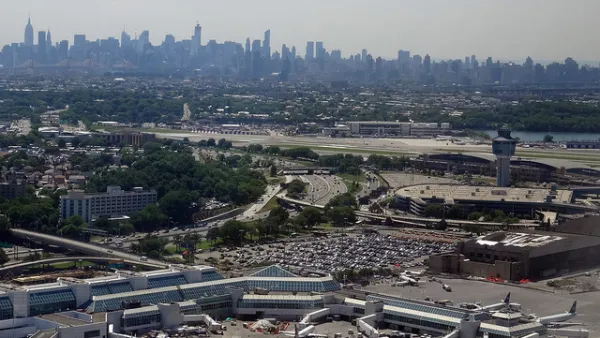
$32 Billion for Port Authority Capital Plan
A plan that includes improvements for LaGuardia, new rail transit and more automotive infrastructure to be completed over the next ten years.
Dubai Eyes Rail Expansion
Officials in Dubai have announced plans to extend the emirate's 75-km rail system to more than 250 km.
The Costs and Benefits of the Canada Line
A new rail line connecting Vancouver to its airport is highly anticipated in the region. The costs and construction disturbances, are causing some concern, however.

Planetizen Federal Action Tracker
A weekly monitor of how Trump’s orders and actions are impacting planners and planning in America.

California plans to bury El Niño’s downpour
If the state plays its cards right, it may be able to store a billion acre-feet of El Niño’s water in aquifers.

Desperate measures: Advocates weigh draining Lake Powell to fill Colorado River
Draining the reservoir could reduce evaporation losses by a couple hundred thousand acre-feet.

Mamdani’s pied-à-terre tax survives legal challenge
A panel of judges found that the plaintiffs failed to demonstrate injury as a result of New York City's implementation of the tax.

Eastern Nebraska is running out of electricity
Data centers and electrification are straining eastern Nebraska’s grid, throttling economic development.

Seattle passes record-breaking transit services expansion
Proposition 1 will double the city’s transit tax to add 95,000 more bus trips and preserve 180,000 bus trips annually.

FREE Course: Walkable City 1: Why Walkability?
After describing his path towards focusing on walkability as the essence of good planning, Jeff Speck marches through his five principal reasons for making more walkable places.
Reinventing Malls: Planning Alchemy—Turning Gray Fields Into Gold
The course focuses on the opportunities and imperatives that shape reinvention of mall sites.

City of Rosemead
Rutgers University, Edward J. Bloustein School of Planning and Public Policy
One Hundred Miles
Hunter College, City University of New York (CUNY)
The Architects Foundation
University of Cincinnati Online
City of Cambridge
Montrose County
The Pocatello Development Authority