“When people feel safe, they ride.”


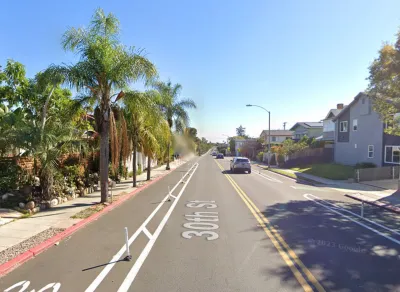
Four years after San Diego installed a protected bike lane on 30th Street, data shows that cycling trips spiked in the year after the lane was installed and have continued growing since.
As Ron Johnson explains in Momentum, annual cycling trips jumped from around 50,000 to 114,682 in the first year after the lane was installed in 2021. “Counts rose another 1.7 per cent in 2023, 5.7 per cent in 2024 and 6.9 per cent in 2025, marking four straight years of growth.”
This data shows that the lanes, which offer access to Balboa Park and connect to other major bikeways, helped change travel behavior in the neighborhood. “What makes 30th Street particularly instructive is how ordinary the opportunity was. The city was already tearing up the road to replace aging pipes. When it resurfaced the street, it chose to build a “complete street” that serves all users.”
Johnson concludes, “For cities looking to meet climate goals or boost local main streets, the lesson is straightforward: when people feel safe, they ride. And when routes connect meaningful destinations, they keep riding.”
FULL STORY: Do Protected Bike Lanes Work? San Diego’s 30th Street Offers Four Years of Proof

San Diego budget axes multimodal team at DOT
The budget scales back funding for some bike lane and traffic safety projects that are already in the works.
The 5 Safest Cities for Cyclists in America — and What They Have in Common
Cities with low fatality rates for people on bikes have made strong commitments to building safe, protected bike networks and supporting Complete Streets.
In Defence of Vision Zero — a Traffic Engineer’s Perspective
Traffic engineers have long suffered the reputation that all we care about is moving cars. The reality could not be more different.

Planetizen Federal Action Tracker
A weekly monitor of how Trump’s orders and actions are impacting planners and planning in America.

The state-sanctioned urbicide of Austin
People don’t kill cities. Freeways do.

US to reduce Colorado River water deliveries to Mexico
A new Colorado Treaty amendment reduces Mexico’s Colorado River water allocation by 250,000 acre feet.

5 New England states march closer to 800 megawatt wind energy project
Securing federal approval for the project may be complicated under the Trump administration, which has historically been hostile towards domestic wind power.

Baltimore to break ground on $50 million Transit Priority Project
The project will bring faster bus trips, safer streets and better bike connections to Baltimore.

Airbnb launches $250 million 'last-dollar financing' housing accelerator, makes first investment in Austin
The company will put $6.4 million towards affordable housing development in Texas’ capital.

FREE Course: Walkable City 1: Why Walkability?
After describing his path towards focusing on walkability as the essence of good planning, Jeff Speck marches through his five principal reasons for making more walkable places.
Reinventing Malls: Planning Alchemy—Turning Gray Fields Into Gold
The course focuses on the opportunities and imperatives that shape reinvention of mall sites.

Eagle County Government
Harvard University Graduate School of Design
Nashville Planning Department
The Architects Foundation
University of Cincinnati Online
The Pocatello Development Authority
The Urban Renewal Agency of the City of Pocatello
Journal of the American Planning Association