Gov. Hochul says New York City will “keep its cameras on.” Can the administration legally end the nation's first cordon pricing program?


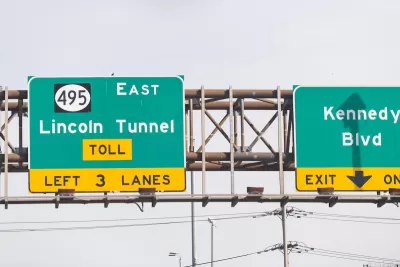
In a piece for Slate, Henry Grabar analyzes the Trump administration’s legal defense for its decision to revoke federal approval for New York City’s congestion pricing program, a move decried by transit activists and New York Governor Kathy Hochul.
In a letter to the governor, Transportation Secretary Sean Duffy pointed to “the lack of toll-free alternative routes and the program’s focus on raising money for mass transit” as reasons to rescind approval.
According to Grabar, the lack of free alternatives is a moot point. “It’s an unsupported theory that seems to open up the question of whether New York must build a free bridge to New Jersey, since all six of the crossings between the states have always been tolled,” Grabar points out.
Roderick Hills Jr., an expert in administrative law at New York University, told Grabar that the reversal is “surprisingly unjustified,” adding, “It’s a complete fabrication devoid of any support in the statutes.”
One silver lining: the decision seems to have shored up approval for the program — and for Kathy Hochul, who last year put a pause on the program for six months until coming up with a lower toll cost. Law professor Greg Shill says the city should “seize the levers it already controls” to “maximize the welfare of its own people” through interventions it can control like bus lanes, traffic enforcement, bike lanes, and pedestrian infrastructure.
FULL STORY: Revenge of the Bridge-and-Tunnel President

Judge Extends NYC Congestion Pricing Through at Least June 9
A federal judge halted the Trump administration’s effort to kill the program, which remains in limbo as a lawsuit filed by the MTA moves forward.

USDOT Threatens to Pull New York Highway Funding
The Trump administration wants the state to kill New York City’s congestion pricing program despite its demonstrated success.
Multiple Lawsuits Aim to Save NYC Congestion Pricing
Environmental and transit advocacy groups, along with the MTA, are suing USDOT over its recent crusade to end the cordon pricing program.

Planetizen Federal Action Tracker
A weekly monitor of how Trump’s orders and actions are impacting planners and planning in America.

The state-sanctioned urbicide of Austin
People don’t kill cities. Freeways do.

US to reduce Colorado River water deliveries to Mexico
A new Colorado Treaty amendment reduces Mexico’s Colorado River water allocation by 250,000 acre feet.

5 New England states march closer to 800 megawatt wind energy project
Securing federal approval for the project may be complicated under the Trump administration, which has historically been hostile towards domestic wind power.

Baltimore to break ground on $50 million Transit Priority Project
The project will bring faster bus trips, safer streets and better bike connections to Baltimore.

Airbnb launches $250 million 'last-dollar financing' housing accelerator, makes first investment in Austin
The company will put $6.4 million towards affordable housing development in Texas’ capital.

FREE Course: Walkable City 1: Why Walkability?
After describing his path towards focusing on walkability as the essence of good planning, Jeff Speck marches through his five principal reasons for making more walkable places.
Reinventing Malls: Planning Alchemy—Turning Gray Fields Into Gold
The course focuses on the opportunities and imperatives that shape reinvention of mall sites.

Eagle County Government
Harvard University Graduate School of Design
Nashville Planning Department
The Architects Foundation
University of Cincinnati Online
The Pocatello Development Authority
The Urban Renewal Agency of the City of Pocatello
Journal of the American Planning Association