The aging Manhattan transit terminal, the world’s busiest, will receive a $10 billion revamp and expansion.


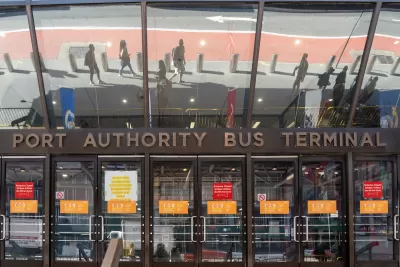
The Port Authority of New York and New Jersey will begin a $10 billion replacement and expansion of its midtown Manhattan bus terminal, the world’s busiest. As Sri Taylor explains in Bloomberg CityLab, the agency secured approval of its environmental review from the Federal Transit Administration, paving the way for construction to begin in 2025.
The new midtown bus terminal will replace the existing over 70-year-old facility, and will include a new 2.1 million square-foot main terminal, a separate storage and staging building, and new ramps leading in and out of the Lincoln Tunnel. The revamp also entails the permanent closure of a portion of 41st Street between Eighth and Ninth avenues, a central main entrance, more street-facing retail, a soaring multi-story indoor atrium and new public open space.
The terminal is expected to fully open in 2032, with a temporary terminal scheduled for completion in 2028.
Read the full story: NYC’s Run-Down Bus Terminal Gets Approval for $10 Billion Revamp

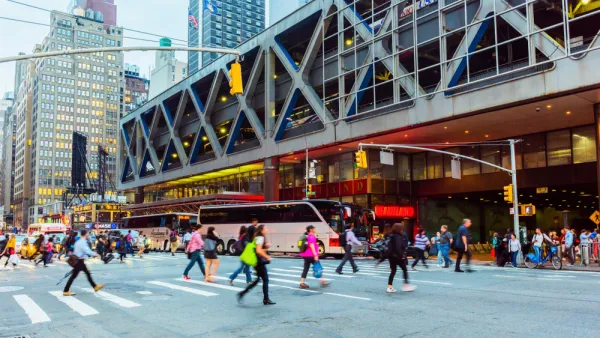
Revealed: Plans for Makeover of the World's Busiest Bus Terminal
The Port Authority Bus Terminal, described as the busiest bus terminal in the world, is due for a makeover, due to its "ragged" appearance and importance to the economy of the New York and New Jersey.
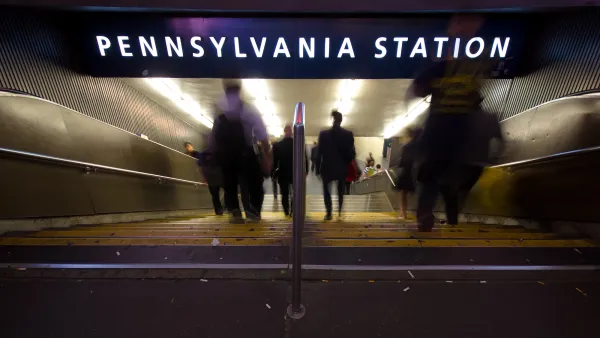
New Penn Station design won't move Madison Square Garden
Amtrak and federal officials agreed on a new plan for the station's redesign that may be largely funded by the federal government.
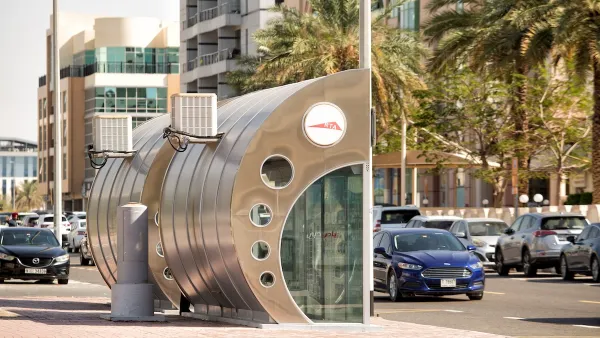
The Value of Beauty at Bus Stops
While some rail stations get the starchitect treatment, most bus stops fail to offer aesthetic value. One study suggests this is a mistake.

Planetizen Federal Action Tracker
A weekly monitor of how Trump’s orders and actions are impacting planners and planning in America.

California plans to bury El Niño’s downpour
If the state plays its cards right, it may be able to store a billion acre-feet of El Niño’s water in aquifers.

Chicago breaks ground on $3 billion megadevelopment
The new neighborhood, titled Foundry Park, will one day host 3,700 residences.

California High-Speed Rail Authority CEO resigns after $600,000 scandal
Under Ian Choudri, the authority used taxpayer dollars to fund first class flights and trips to nightclubs.

Want to study the Missouri River? Soon, you may need unanimous approval from 10 states
Legislation would require 10 governors’ permission to study or build projects moving water outside the basin.

Desperate measures: Advocates weigh draining Lake Powell to fill Colorado River
Draining the reservoir could reduce evaporation losses by a couple hundred thousand acre-feet.

FREE Course: Walkable City 1: Why Walkability?
After describing his path towards focusing on walkability as the essence of good planning, Jeff Speck marches through his five principal reasons for making more walkable places.
Reinventing Malls: Planning Alchemy—Turning Gray Fields Into Gold
The course focuses on the opportunities and imperatives that shape reinvention of mall sites.

City of Rosemead
Rutgers University, Edward J. Bloustein School of Planning and Public Policy
One Hundred Miles
Hunter College, City University of New York (CUNY)
The Architects Foundation
University of Cincinnati Online
City of Cambridge
Montrose County
The Pocatello Development Authority