Dead malls across the Bay Area are being transformed into R&D centers, housing, and transportation hubs.


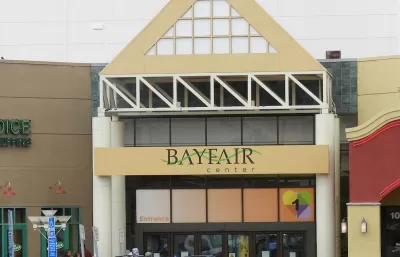
With more and more American malls closing, their potential for redevelopment is growing. In the San Francisco Bay Area, a 400,000-square-foot project will reimagine the former Bayfair Center mall into a research and development center for tech companies.
As Chase Hunter explains in an article on SiliconValley.com, “The mall’s interior officially closed in early 2023, but the loss of Macy’s in April 2024 – a store that had been a tenant since the mall opened in 1957 – marked a turning point as developers focused on creating a new iteration of the property.” The property provides convenient access to existing infrastructure including the power and air conditioning necessary for R&D centers.
The trend is catching on in other parts of Silicon Valley. “In the South Bay, the city of Cupertino agreed in July with the owners of the Vallco Mall property to permit the construction of 2,700 housing units, with about a third set aside for affordable housing. And Prologis, a San Francisco-based real estate company that owns Hilltop Mall in Richmond, hopes to create a data center, a transportation hub and hundreds of housing units in collaboration with the city’s specific plan to redevelop the 145-acre area around the mall.”
Cities are taking notice, in some cases adjusting their zoning codes to make it easier for developers to adaptively reuse malls and encourage transit-oriented, mixed-use development. Meanwhile, the Bay Area Rapid Transit (BART) agency moved up the timeline for a station near Bayfair, “citing the Bay Fair station’s high rankings in development streamlining, market readiness for offices and development capacity.”
FULL STORY: What will happen to the Bay Area’s millions of square feet of closed mall space?

A Second Life for the American Mall
‘Dead’ suburban malls, with their existing infrastructure, offer a variety of opportunities for redevelopment into everything from housing to parks.
The Mall Is Dead — Long Live the Mall
The American shopping mall may be closer to its original vision than ever.
The Evolution of Retail Centers
Catalytic developments initiate economic and cultural improvements.

Planetizen Federal Action Tracker
A weekly monitor of how Trump’s orders and actions are impacting planners and planning in America.

The state-sanctioned urbicide of Austin
People don’t kill cities. Freeways do.

US to reduce Colorado River water deliveries to Mexico
A new Colorado Treaty amendment reduces Mexico’s Colorado River water allocation by 250,000 acre feet.

Mamdani overhauls NYC's Vision Zero plan with 100 new policy goals
The overhaul aims to reduce traffic deaths and make streets safer for pedestrians, cyclists and drivers through lower speed limits, new safety infrastructure and more.

Amtrak not solely to blame for New Jersey commuter rail's unreliability, report finds
A new study from the Garden State Initiative found that NJ Transit’s budget grew 20% across a 4 year period, but reliability declined significantly over the same period.

EPA erases limits on planet-warming pollution from power plants
Under Monday’s plan, power plants would still have some limits on how much mercury, arsenic and other contaminants they can emit.

FREE Course: Walkable City 1: Why Walkability?
After describing his path towards focusing on walkability as the essence of good planning, Jeff Speck marches through his five principal reasons for making more walkable places.
Reinventing Malls: Planning Alchemy—Turning Gray Fields Into Gold
The course focuses on the opportunities and imperatives that shape reinvention of mall sites.


Eagle County Government
Harvard University Graduate School of Design
Nashville Planning Department
The Architects Foundation
University of Cincinnati Online
The Pocatello Development Authority
The Urban Renewal Agency of the City of Pocatello
Journal of the American Planning Association