Caltrans will soon close half of the 101 Freeway in order to continue construction of the Wallis Annenberg Wildlife Crossing near Agoura Hills in Los Angeles County.


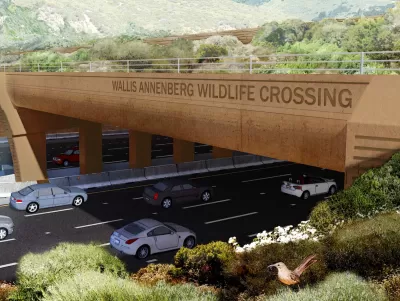
Located at Liberty Canyon and the 101 Freeway, the Wallis Annenberg Wildlife Crossing is a public-private partnership that has leveraged the expertise and leadership of numerous organizations and institutions. The core partners include Caltrans, the National Park Service, the Santa Monica Mountains Conservancy, Mountains Recreation and Conservation Authority, Resource Conservation District of the Santa Monica Mountains, and the National Wildlife Federation.
The purpose of the project is to provide a safe and sustainable passage for wildlife across the 101 Freeway near Liberty Canyon Road in Agoura Hills to reduce wildlife death and allow for the movement of animals and the exchange of genetic material. Without a safe and sustainable wildlife crossing, movement between these remaining areas of natural habitat is severely restricted and wildlife within the Santa Monica Mountains is essentially trapped.
As reported by Makenna Sievertson in this article, Caltrans will be closing all southbound lanes of the 101 Freeway in Agoura Hills for five hours each night for construction on the wildlife crossing starting Monday, April 15th, 2024. Specifically, crews will be installing the first girders, an approximately 100-foot-long box of reinforced concrete that will serve as the base level of the wildlife crossing. The girders will help support the structure’s horizontal reach across one of the country’s busiest highways.
The closure will extend from Liberty Canyon to Chesebro roads, but the northbound lanes will remain open and there will be detours available for drivers. Breaking ground on Earth Day in 2022, the project is anticipated to be completed by early 2026. For additional information, please read the source article.
FULL STORY: Wildlife Crossing Closures Coming For 101 Freeway

California invests $2.7 billion in over 150 transportation projects
The fund allocates money to transit upgrades and safety improvements to streets surrounding schools, among other ventures.

Colorado creates wildlife crossings fund
Residents will have the option to add $5 to their car registration to fund infrastructure that prevents wildlife-vehicle collisions.
Arizona emerges as national leader in wildlife crossings
Arizona has been building bridges to prevent wildlife-vehicle collisions at various hotspots throughout the state.

Planetizen Federal Action Tracker
A weekly monitor of how Trump’s orders and actions are impacting planners and planning in America.

The state-sanctioned urbicide of Austin
People don’t kill cities. Freeways do.

US to reduce Colorado River water deliveries to Mexico
A new Colorado Treaty amendment reduces Mexico’s Colorado River water allocation by 250,000 acre feet.

Mamdani overhauls NYC's Vision Zero plan with 100 new policy goals
The overhaul aims to reduce traffic deaths and make streets safer for pedestrians, cyclists and drivers through lower speed limits, new safety infrastructure and more.

Amtrak not solely to blame for New Jersey commuter rail's unreliability, report finds
A new study from the Garden State Initiative found that NJ Transit’s budget grew 20% across a 4 year period, but reliability declined significantly over the same period.

EPA erases limits on planet-warming pollution from power plants
Under Monday’s plan, power plants would still have some limits on how much mercury, arsenic and other contaminants they can emit.

FREE Course: Walkable City 1: Why Walkability?
After describing his path towards focusing on walkability as the essence of good planning, Jeff Speck marches through his five principal reasons for making more walkable places.
Reinventing Malls: Planning Alchemy—Turning Gray Fields Into Gold
The course focuses on the opportunities and imperatives that shape reinvention of mall sites.

Eagle County Government
Harvard University Graduate School of Design
Nashville Planning Department
The Architects Foundation
University of Cincinnati Online
The Pocatello Development Authority
The Urban Renewal Agency of the City of Pocatello
Journal of the American Planning Association