The state of Washington is hoping federal infrastructure funding can pay for $198 million of the $348 million necessary to plan the Cascadia High-Speed Rail project.


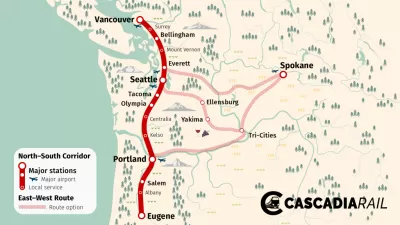
Legislators in the state of Washington are applying for $198 million in federal funding from the Infrastructure Investment and Jobs act to fund planning work for a proposed 290-mile high-speed rail route connecting Portland, Oregon to Vancouver, British Columbia, with stops along the way including Seattle, Tacoma, Olympia, and more.
Mike Lindblom reports that Washington State legislators sent a letter to U.S. Transportation Secretary Pete Buttigieg making the case for the funding.
Plans call for an electric-powered system that would reach top speeds of 250 miles per hour, according to Lindblom. “The Cascadia high-speed corridor would be faster than any trains that currently operate in the United States, though contractors are now building a starter bullet-train line in central California,” according to Lindblom.
The project is still in relatively nascent stages. “So far, proponents haven’t clearly explained where to place dedicated tracks so they’re apart from other trains, motor vehicles and people, allowing 250 mph travel. That’s what a $348 million planning investment is for,” explains Lindblom.
A report on the project, submitted to the Washington State Legislature in June 2023, estimates the total cost of the project at $42 billion in 2017 dollars. However, an independent legislative review also published in June adjusted the estimate to $63 billion in 2023 dollars, based on construction inflation.
FULL STORY: WA Democrats ask Buttigieg for $200M to plan Canada-Seattle-Portland bullet train

Economic Stimulus: Another Chance for High-Speed Rail in the U.S.?
High-speed rail advocates in the Pacific Northwest are pushing for a high-speed link between Vancouver, Seattle, and Portland to be part of future economic stimulus spending in the United States.

Cascadia High Speed Rail Authority Has its First Funding
The state of Washington has allocated funding from its 2019-2021 biennium transportation appropriations bill to study the creation of the Cascadia High Speed Rail Authority.
An Interstate High-Speed Rail Authority on the Legislative Agenda in Washington
A big idea is gaining momentum.

The state-sanctioned urbicide of Austin
People don’t kill cities. Freeways do.

US to reduce Colorado River water deliveries to Mexico
A new Colorado Treaty amendment reduces Mexico’s Colorado River water allocation by 250,000 acre feet.

New Jersey’s second-largest city bans standalone data centers
Jersey City will continue to allow co-location facilities, such as those meant for research institutions that store their own data.

Amtrak not solely to blame for New Jersey commuter rail's unreliability, report finds
A new study from the Garden State Initiative found that NJ Transit’s budget grew 20% across a 4 year period, but reliability declined significantly over the same period.

EPA erases limits on planet-warming pollution from power plants
Under Monday’s plan, power plants would still have some limits on how much mercury, arsenic and other contaminants they can emit.

Phoenix announces new on-demand transit service, more frequent RAPID buses
Both new services will launch in October, and are part of Phoenix's Project Effective Access Solutions for Easing Congestion.

FREE Course: Walkable City 1: Why Walkability?
After describing his path towards focusing on walkability as the essence of good planning, Jeff Speck marches through his five principal reasons for making more walkable places.
Reinventing Malls: Planning Alchemy—Turning Gray Fields Into Gold
The course focuses on the opportunities and imperatives that shape reinvention of mall sites.

Eagle County Government
Harvard University Graduate School of Design
Nashville Planning Department
The Architects Foundation
University of Cincinnati Online
The Pocatello Development Authority
The Urban Renewal Agency of the City of Pocatello
Journal of the American Planning Association