A two-year pilot program aims to provide an integrated, multimodal, and affordable transportation system across the city combining transit, bikes, e-scooters, and other options.



Writing in Government Technology, Skip Descant describes the city of Pittsburgh’s Move PGH mobility-as-a-service pilot program, a two-year experiment that focuses on creating an integrated, affordable, and accessible multimodal transportation system.
According to Descant, “Affordable and accessible transportation has become a policy goal at all levels of government, as officials concede it is essential to ensure access to jobs, health care, education and offers a path to upward mobility that lifts people from poverty.” As such, Pittsburgh’s program offers a 30 percent discount on rides taken in geographic “equity areas,” as well as an 80 percent discount for income-qualified residents. “So far, nearly one million trips have been taken on about 1,000 scooters in Pittsburgh, with about 200,000 people signing up to use the Spin scooters. Based on survey data, more than a third of those million trips would have been taken in a car, were the scooters not available.”
As Descant explains, “Move PGH is a pilot which city officials would like to see evolve into a more permanent fixture in Pittsburgh. That will require some action at the state level to allow e-scooters. The devices are allowed to only operate in Pittsburgh, and only as part of the pilot.”
Read the full story: Pittsburgh Mobility Pilot Builds on Transportation Equity Goals

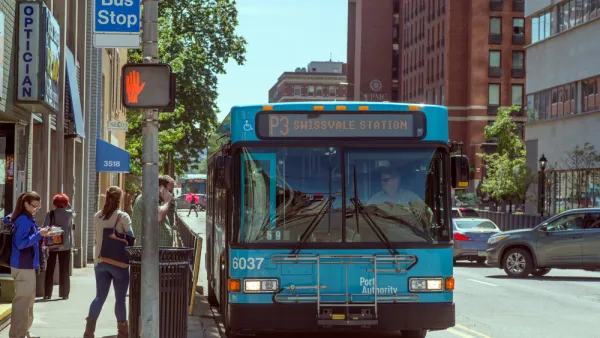
Pittsburgh Launches Guaranteed Basic Mobility Pilot
The program aims to improve access to jobs and economic opportunities for some of the city’s most underserved neighborhoods.
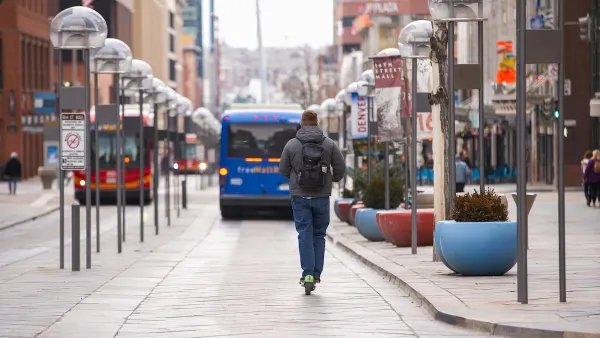
Denver Transit Agency Will Subsidize First Mile of Shared Scooter Trips
A pilot program seeks to address the problem of transit access by paying for the first mile of trips to and from two light rail stations.
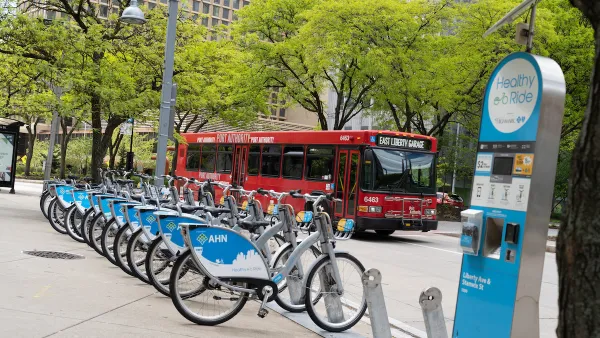
Micromobility Operators Call for Better Links to Transit
For shared mobility to succeed, systems must tap into the connectivity and funding potential offered by closer collaboration with public transit.

Planetizen Federal Action Tracker
A weekly monitor of how Trump’s orders and actions are impacting planners and planning in America.

California plans to bury El Niño’s downpour
If the state plays its cards right, it may be able to store a billion acre-feet of El Niño’s water in aquifers.

Desperate measures: Advocates weigh draining Lake Powell to fill Colorado River
Draining the reservoir could reduce evaporation losses by a couple hundred thousand acre-feet.

California city breaks ground on transit connector
The project includes three mobility hubs and a pedestrian bridge.

After public outcry, Massachusetts city releases housing development tracker
Cambridge’s tracker currently shows 250 housing projects in various stages of development.

40 years after approval, Chicago breaks ground on new park
The park honors Jean Baptiste Point du Sable, the city’s first permanent non-native settler.

FREE Course: Walkable City 1: Why Walkability?
After describing his path towards focusing on walkability as the essence of good planning, Jeff Speck marches through his five principal reasons for making more walkable places.
Reinventing Malls: Planning Alchemy—Turning Gray Fields Into Gold
The course focuses on the opportunities and imperatives that shape reinvention of mall sites.

City of Rosemead
Rutgers University, Edward J. Bloustein School of Planning and Public Policy
One Hundred Miles
Hunter College, City University of New York (CUNY)
The Architects Foundation
University of Cincinnati Online
City of Cambridge
Montrose County
The Pocatello Development Authority